Keto Planked Salmon: Mustard-Dill Crust Instead of Honey Glaze
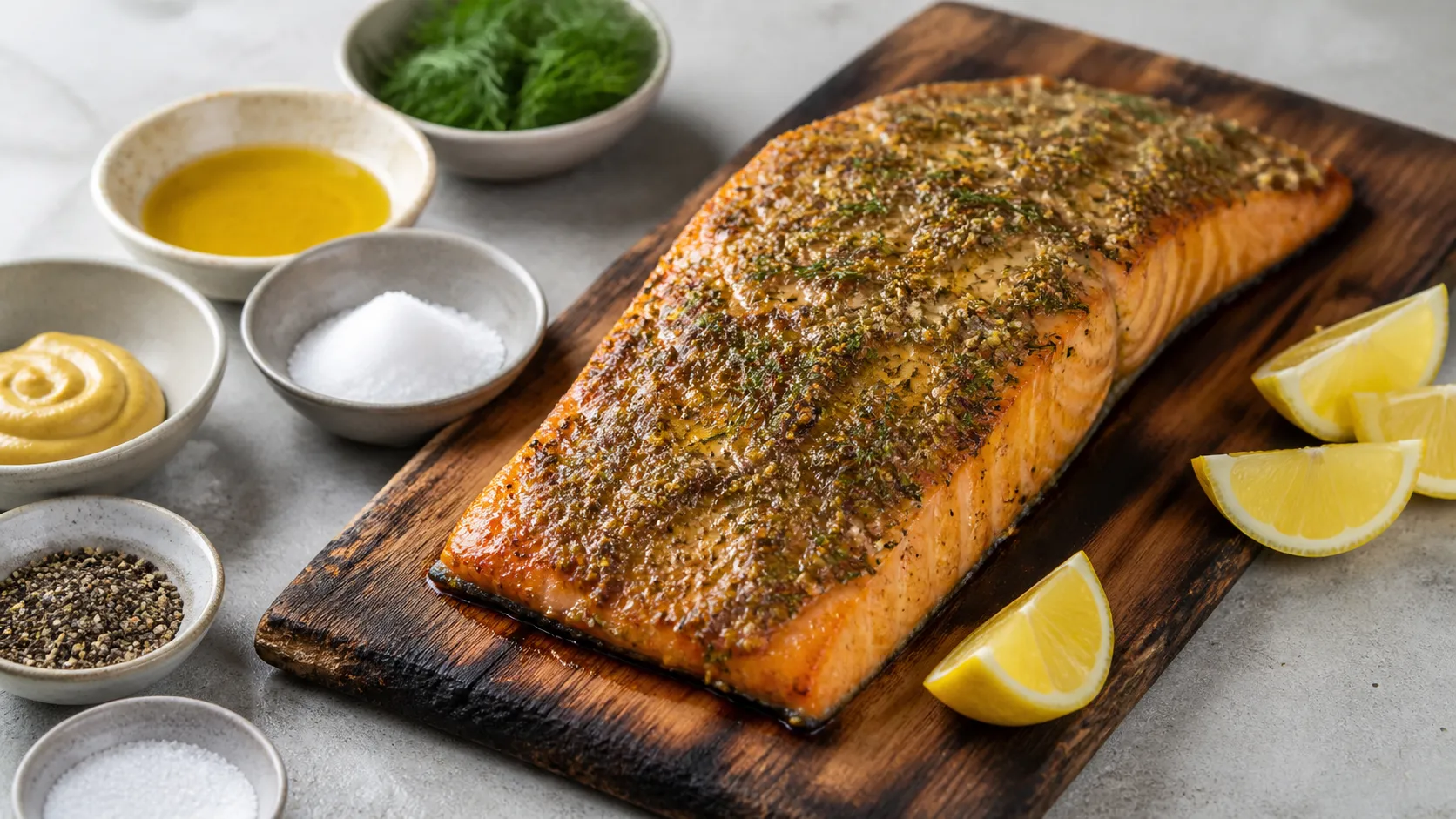
Keto planked salmon is one of the few barbecue classics that already fits on the raw-ingredient level: salmon has zero carbs and delivers, at approx. 13 g fat per 100 g, exactly the fatty acids that make keto attractive. The sugar sits elsewhere - in the classic cure of salt and sugar in equal parts, and in the honey-mustard glaze. This version replaces both and stays at approx. 1 g net carbs per serving.
The key facts at a glance
- Time required: approx. 50 minutes of active work plus 60 minutes of curing in the fridge.
- Only approx. 1 g net carbs and 28 g fat at 35 g protein per serving.
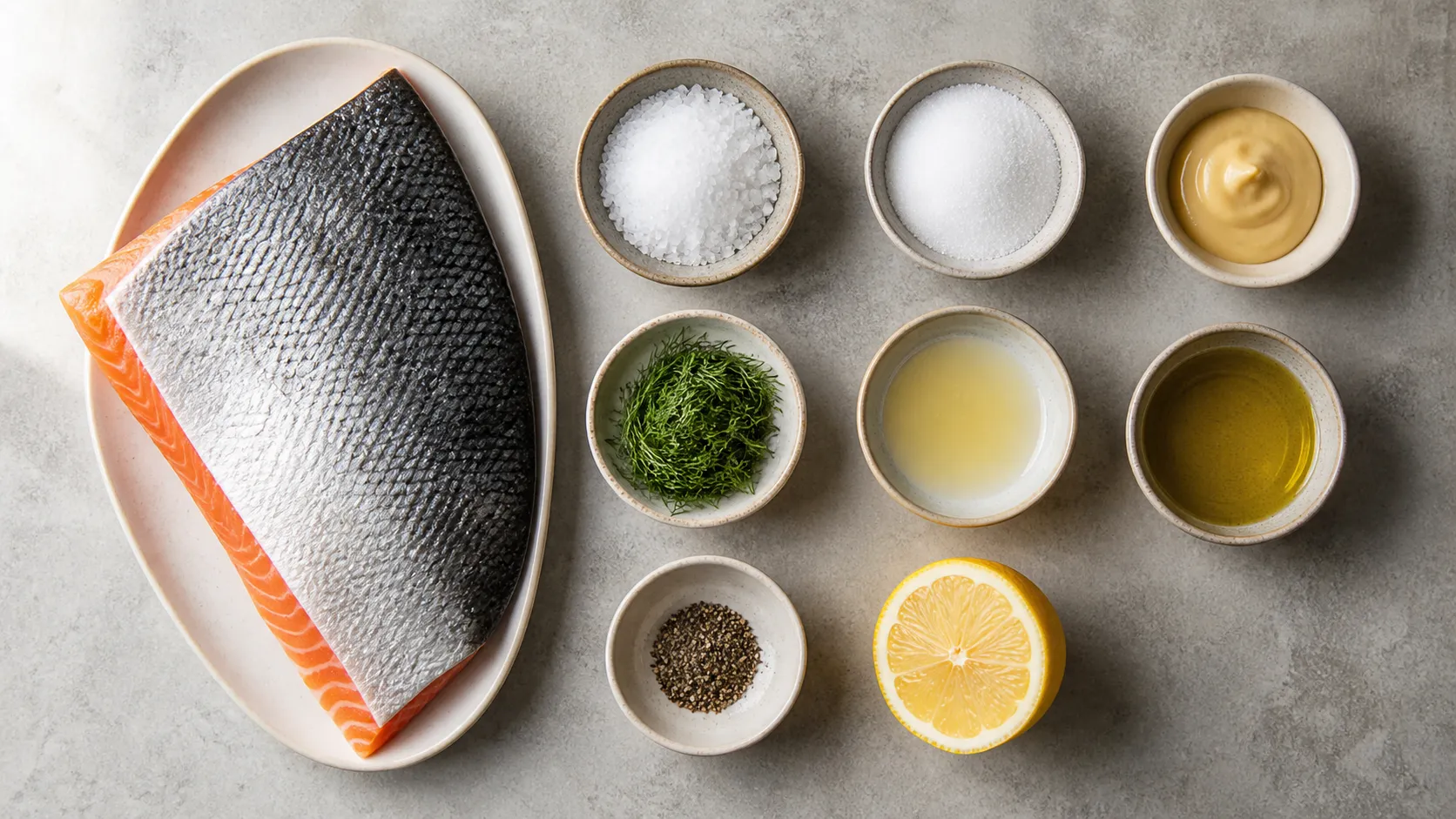
- Ingredients: side of salmon with skin, sea salt, erythritol, Dijon mustard, dill, lemon, olive oil.
- Works as a main course from the grill, for guests and as a high-protein summer meal.
Ingredients
One serving is approx. 175 g of salmon with skin; as a starter or part of a larger barbecue spread the side also feeds 6 people.
| Amount | Ingredient | Note | ||
|---|---|---|---|---|
| salmon fillet | one side with skin, pin-boned | |||
| one side with skin, pin-boned | ||||
| sea salt | coarse, for the dry cure | |||
| coarse, for the dry cure | ||||
| erythritol | for the dry cure | |||
| for the dry cure | ||||
| Dijon mustard | approx. 2 tbsp, replaces the honey glaze | |||
| approx. 2 tbsp, replaces the honey glaze | ||||
| dill | fresh, finely chopped | |||
| fresh, finely chopped | ||||
| lemon juice | juice of half a lemon | |||
| juice of half a lemon | ||||
| olive oil | - | |||
| pepper | freshly ground | |||
| freshly ground | ||||
How it is made
-
Soak the plank
approx. 2 minutes plus 60 minutes waitingCover the untreated cedar or beech plank completely with water and soak it for at least 1 hour, preferably overnight. A plate as a weight keeps it submerged.
-
Cure
approx. 5 minutes plus 60 minutes curing700 g salmon fillet one side with skin, pin-boned 20 g sea salt coarse, for the dry cure 10 g erythritol for the dry cure Mix the sea salt (20 g) and erythritol (10 g) and spread the mixture evenly over the flesh side of the salmon (700 g). Cover and refrigerate for 60 minutes - liquid visibly draws out during this time.
-
Rinse and mix the crust
approx. 10 minutes30 g Dijon mustard approx. 2 tbsp, replaces the honey glaze 10 g dill fresh, finely chopped 20 ml lemon juice juice of half a lemon 20 ml olive oil 0.5 tsp pepper freshly ground Rinse the salmon under cold water and pat it thoroughly dry with kitchen paper. Stir together the Dijon mustard (30 g), chopped dill (10 g), lemon juice (20 ml), olive oil (20 ml) and pepper (0.5 tsp) and spread the mixture thickly over the fillet.
-
Set up the grill
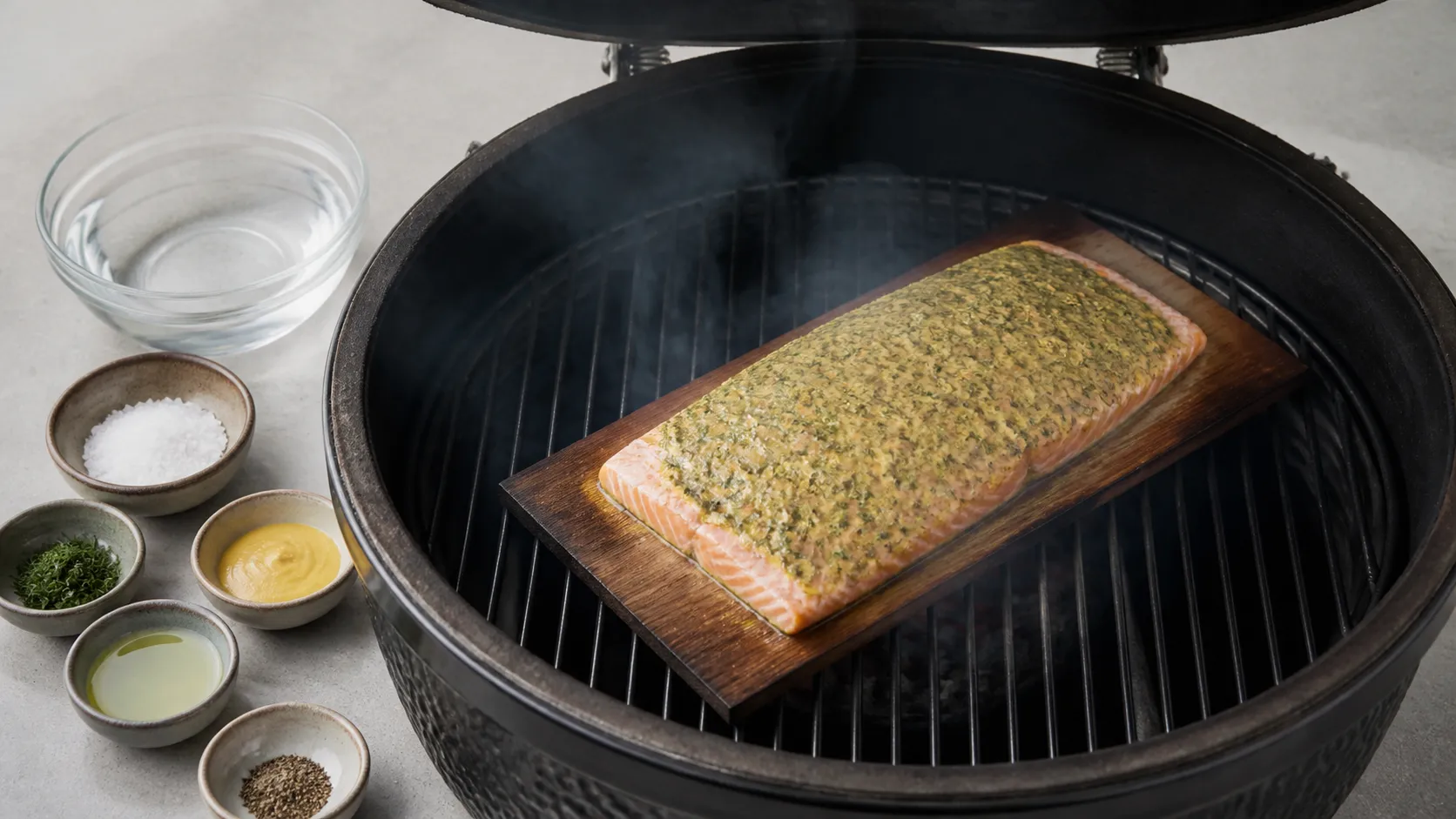
approx. 5 minutesBring the grill to approx. 200 degrees Celsius and set up an indirect zone. Lay the wet plank briefly over the direct heat until it starts to crackle, then turn it over and place the salmon on it skin side down.
-
Cook indirectly
approx. 30 minutes, hands-offSlide the plank into the indirect zone and close the lid. After 25 to 30 minutes the core temperature should be 55 degrees Celsius and the mustard crust dark. Serve on the plank and lift the portions off the skin.
Which tips help with planked salmon on the grill?
- Soak the plank for at least 1 hour, ideally overnight - dry wood burns instead of smoking.
- Use only untreated cedar, beech or alder, never varnished or glued boards.
- Rinse the cure off thoroughly after 60 minutes and pat the fish dry, or it turns out too salty.
- Spread the mustard crust on only after rinsing, so it does not run off in the curing liquid.
- Grill with the lid closed over indirect heat and stand a water container next to the fish.
- Take the salmon off at a core temperature of 55 degrees Celsius - it carries on cooking on the hot plank.
Why this planked salmon works on keto
Salmon brings ideal credentials to a keto main course: zero carbs, approx. 20 g protein and approx. 13 g fat per 100 g, a substantial share of it long-chain omega-3 fatty acids. Planked salmon only becomes a carb carrier through the way it is prepared. The traditional cure works with salt and sugar in a one-to-one ratio, and the typical glaze relies on honey or brown sugar so that a dark, sticky layer forms over the fire - together that adds up to 6 to 10 g carbs per serving fast. Here erythritol takes over the flavor role of the sugar in the cure, and Dijon mustard takes the role of the glaze: it clings, it browns via its own protein, and it brings the sharpness that suits an oily fish. The rest is dill and lemon. Nutrition values for salmon can be looked up in the FDDB nutrition database.
Source: FDDB nutrition database
What the sugar in a cure actually does
In a dry cure, the salt does all of the work: it draws water out of the fish by osmosis, firms up the protein and makes the flesh sliceable. The sugar is pure flavor balance - it takes the hard edge off the salt. That is precisely the job erythritol can take over, because it needs no sugar chemistry, only sweetness. The ratio shifts in favour of the salt in the process, because erythritol has only about 70 percent of the sweetening power of sugar; two parts salt to one part erythritol is the right starting point for an hour of curing.
Source: German Federal Institute for Risk Assessment: fish and fish products
A plank rather than an open flame
The original is nailed to a board and stood at an angle beside an open fire, where it cooks by radiant heat for two to three hours. On a kettle or gas grill you reach the same result in 30 minutes by laying the plank flat in the indirect zone: the soaked wood releases moisture, starts to smolder at the edges and delivers exactly the smoke the dish is named for. Soaking is what matters - at least an hour, ideally overnight. A dry plank burns instead of smoking.
How do I serve and vary the planked salmon?
Serve the salmon straight on the plank and lift the portions off the skin with a spoon - the skin stays behind on the wood, which makes portioning easier. In practice the most common mistake is cooking it too long: at a core temperature of 55 degrees Celsius the salmon is still translucent inside, and that is exactly where it is juicy. If you prefer it cooked through, go to 58 degrees Celsius, but no further.
Meal prep, prepping ahead and storing
The cure can be mixed weeks in advance, the plank can be soaked at any time, and the mustard-dill crust keeps for 3 days in a jar. The cured and rinsed salmon can wait in the fridge for 12 hours before grilling - it even gets slightly firmer that way. Cooked planked salmon keeps for 2 days refrigerated and is excellent cold: flaked over leaf salad, or with cream cheese as a spread for keto bread.
Without a grill: oven and pan
The same plank works in the oven at 200 degrees Celsius conventional heat on the middle shelf; only the smoke aroma is missing, and half a teaspoon of smoked paprika powder in the mustard crust gets close. Without a plank, lay the salmon skin side down on a lined baking tray - the cooking time stays at 25 to 30 minutes. Instead of salmon, char, sea trout and rainbow trout all work; they are slightly leaner and need 5 minutes less.
Nutrition values
| Nutrient | Per 100 g | Per serving | Keto context |
|---|---|---|---|
| Calories | approx. 213 kcal | approx. 405 kcal | Filling main course; with grilled vegetables a complete plate under 500 kcal. |
| Filling main course; with grilled vegetables a complete plate under 500 kcal. | |||
| Fat | approx. 15 g | approx. 28 g | High and mostly from the fish itself, including long-chain omega-3 fatty acids. |
| High and mostly from the fish itself, including long-chain omega-3 fatty acids. | |||
| Net carbs | approx. 0.5 g | approx. 1 g | Practically zero; the erythritol in the cure does not count and is largely rinsed away. |
| Practically zero; the erythritol in the cure does not count and is largely rinsed away. | |||
| Sugar | approx. 0.2 g | approx. 0.4 g | Only natural sugar from mustard and lemon - no honey, no brown sugar. |
| Only natural sugar from mustard and lemon - no honey, no brown sugar. | |||
| Protein | approx. 18 g | approx. 35 g | Very high; salmon is one of the densest protein sources in keto cooking. |
| Very high; salmon is one of the densest protein sources in keto cooking. | |||
| Salt | approx. 0.8 g | approx. 1.5 g | Pronounced because of the cure, but predictable, since it is rinsed off before grilling. |
| Pronounced because of the cure, but predictable, since it is rinsed off before grilling. | |||
Note: Nutrition values are estimated averages per 100 g and per serving and may vary depending on ingredients, brands, portion size, and preparation. They do not replace individual nutrition or medical advice.
FAQ
Is classic planked salmon keto-friendly?
The fish is, the preparation usually is not. The traditional cure is salt and sugar in equal parts, and the usual glaze relies on honey or brown sugar - together that is 6 to 10 g carbs per serving. With erythritol in the cure and Dijon mustard instead of a glaze, approx. 1 g of that remains.
Which wood is suitable for the grilling plank?
Untreated cedar, beech, alder or fruitwood. Cedar gives the classic resinous, faintly sweet aroma; alder is milder and suits fish better if you want the smoke to stay discreet. Never use varnished, oiled or glued boards, or softwoods other than cedar - their resins taste bitter and are not meant to be heated.
Can I leave out the sweetener entirely?
Yes. A pure salt cure works exactly the same technically, because the salt alone does the water extraction. The salmon does taste noticeably sharper on the salt side, though. If you work without a sweetener, shorten the curing time to 40 minutes and rinse especially thoroughly.
Does planked salmon suit weight loss on keto?
Very well. 35 g protein per serving is very filling, and the 405 kcal come almost entirely from protein and fish fat - with no hidden oil or breading. If you are planning more tightly, use 140 g instead of 175 g of salmon per serving; the carb figure does not change.