Keto Cream Cheese Cake (No-Bake)
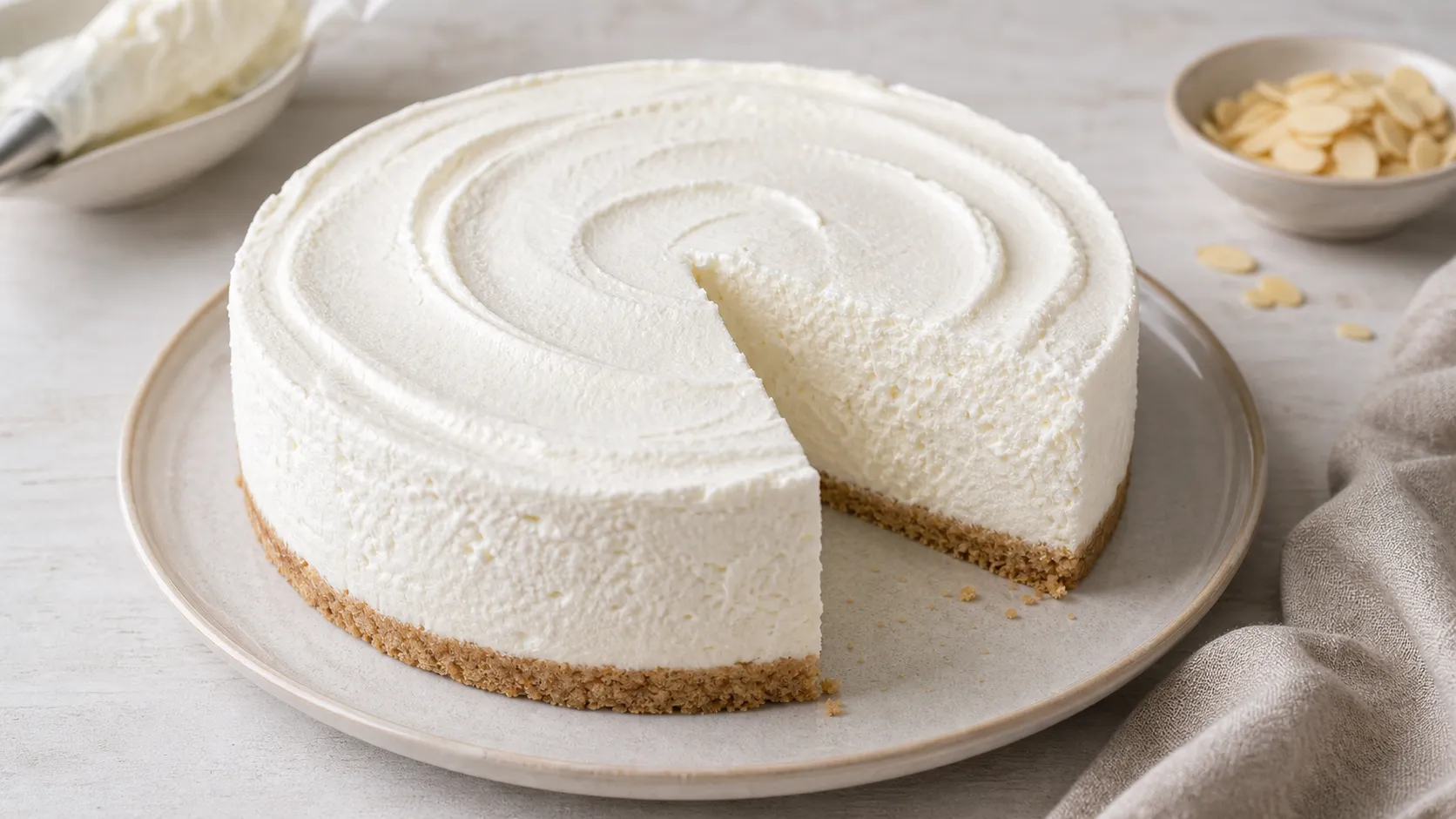
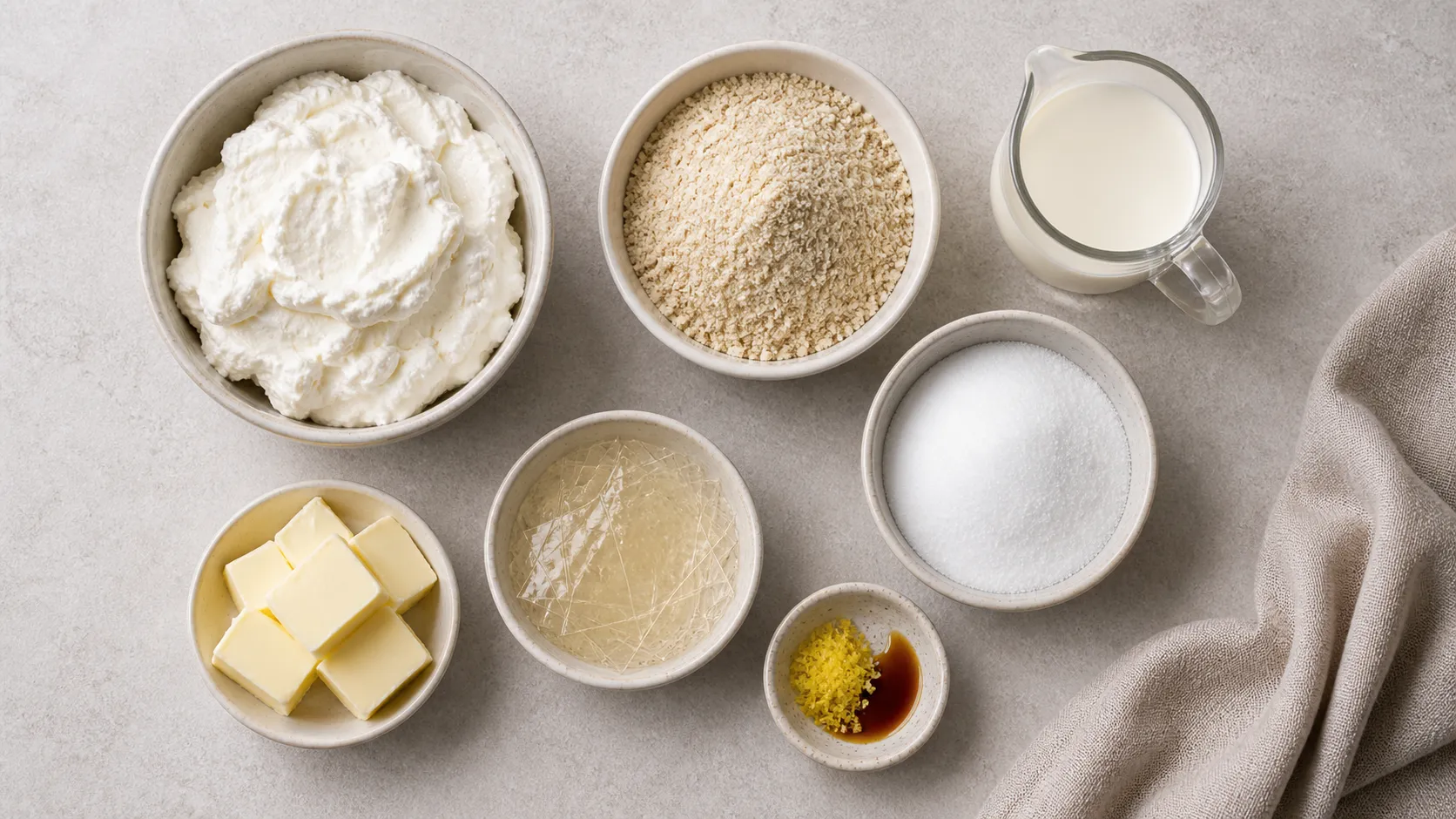
The classic German Käse-Sahne-Torte made with sponge base, quark, cream, and sugar comes in at around 28 g of carbs per slice. This no-bake keto version swaps the sponge for an almond flour and butter crust and uses a blend of low-fat quark, full-fat cream cheese, and stiffly whipped cream as the filling. Gelatin gives it that classic sliceable, airy texture. The result: 4 g net carbs per slice with the full whipped-cream-cake flavor.
Key facts at a glance
- Prep time: approx. 20 minutes active + 4 hours chilling, makes 12 slices.
- Approx. 4 g net carbs and 22 g fat per slice.
- Ingredients: almond flour, butter, low-fat quark, full-fat cream cheese, cream, erythritol, gelatin, vanilla, lemon juice.
- Great for coffee time or as a dessert, keeps for 3 days in the fridge, not freezer-friendly.
Ingredients
The recipe makes 12 slices from a 24 cm (9.5 inch) springform pan. One serving for coffee time is 1 slice (approx. 130 g).
| Amount | Ingredient | Note | ||
|---|---|---|---|---|
| Almond flour (blanched) | for the crust | |||
| for the crust | ||||
| Butter (melted) | for the crust | |||
| for the crust | ||||
| Erythritol | for the crust | |||
| for the crust | ||||
| Salt | - | |||
| Low-fat quark | - | |||
| Full-fat cream cheese (room temperature) | - | |||
| Erythritol (powdered) | for the cream | |||
| for the cream | ||||
| Vanilla extract | approx. 2 tsp | |||
| approx. 2 tsp | ||||
| Lemon juice | approx. 1 tbsp | |||
| approx. 1 tbsp | ||||
| Gelatin | sheet gelatin | |||
| sheet gelatin | ||||
| Heavy cream (30%) | - | |||
Preparation
-
Prepare and bake the crust
approx. 35 minutes180 g Almond flour (blanched) for the crust 80 g Butter (melted) for the crust 30 g Erythritol for the crust 1 pinch Salt 120 g Erythritol (powdered) for the cream Preheat the oven to 160 °C (320 °F, conventional). Line a 24 cm (9.5 inch) springform pan with parchment paper. Combine almond flour (180 g), melted butter (80 g), erythritol (30 g), and salt into a crumbly dough. Press into the pan and pre-bake for 10 minutes, this makes the crust crisp. Let cool completely (approx. 20 min.).
-
Mix the quark and cream cheese filling
approx. 5 minutes500 g Low-fat quark 250 g Full-fat cream cheese (room temperature) 10 ml Vanilla extract approx. 2 tsp 15 ml Lemon juice approx. 1 tbsp 6 sheet Gelatin sheet gelatin 400 ml Heavy cream (30%) Soak the gelatin (6 sheets) in cold water for 5 minutes. In a large bowl, stir low-fat quark (500 g) and cream cheese (250 g, room temperature) smooth with a hand mixer on low speed. Stir in powdered erythritol (120 g), vanilla (2 tsp), and lemon juice (1 tbsp).
-
Dissolve and incorporate the gelatin
approx. 5 minutesFirmly squeeze out the soaked gelatin and transfer to a small bowl. Dissolve over a water bath or 20 seconds in the microwave on low, do not boil, or the gelatin will lose its setting power. FIRST whisk the dissolved gelatin with 2 tbsp of the quark mixture (tempering, prevents clumps), then stir into the main mixture.
-
Fold in the whipped cream
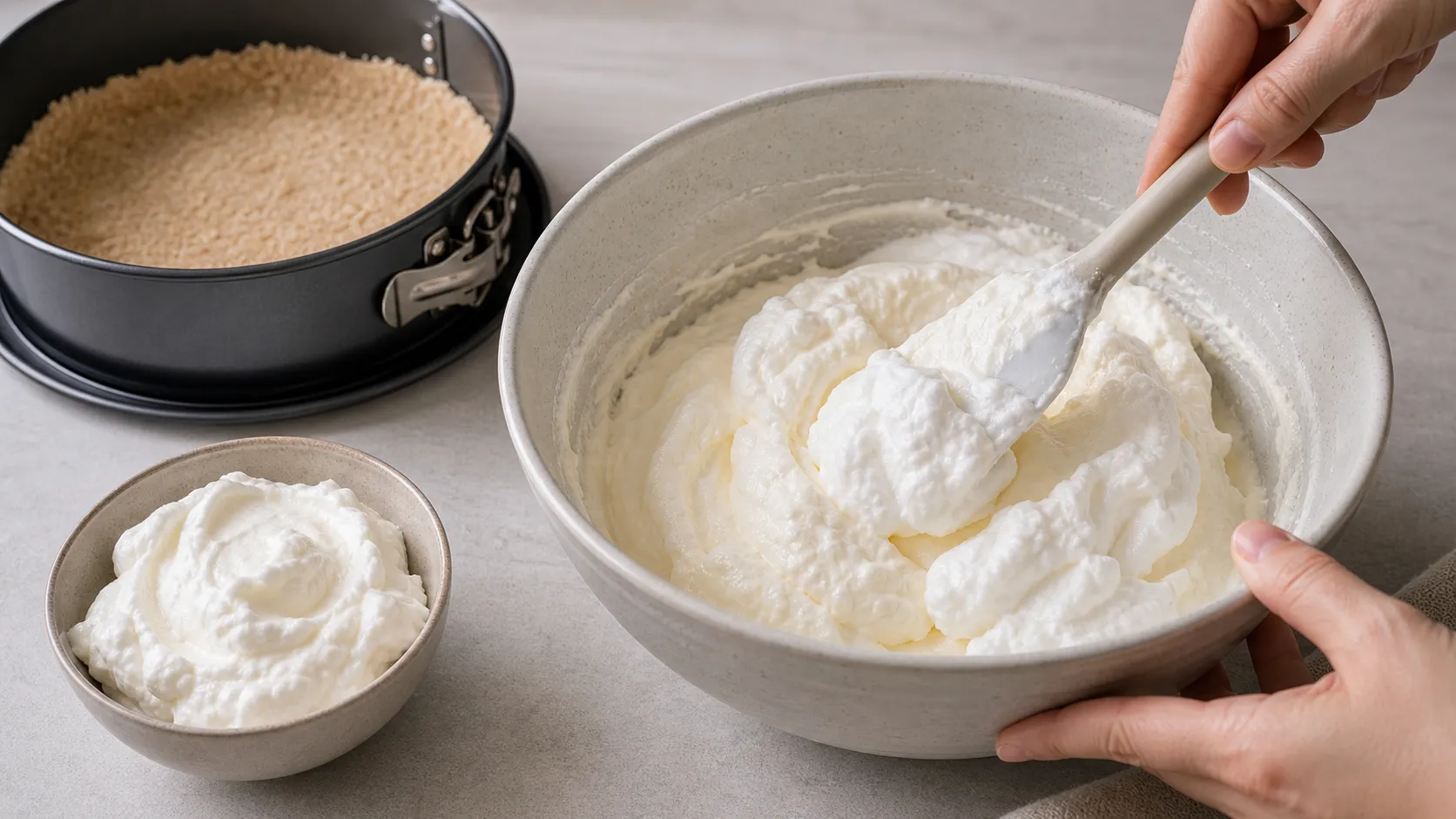
approx. 5 minutesWhip the cream (400 ml) in a cold bowl with cold beaters until stiff, stop as soon as stiff peaks form. Using a spatula, carefully fold into the quark and cream cheese mixture in 3 portions. Don't stir too long, or the cream will lose its airiness.
-
Layer and chill
approx. 240 minutes (chilling)Spread the cream onto the cooled crust and smooth the top with an offset spatula. Cover with foil and chill in the fridge for at least 4 hours, preferably overnight, to set. Only then carefully release the springform ring and slice into 12 equal pieces with a warm knife.
Which tips help with keto cream cheese cake?
- Soak the gelatin in cold water (5 min.), then squeeze out and dissolve in the microwave for 20 seconds or over a water bath.
- Temper the dissolved gelatin first with 2 tbsp of the quark mixture, then stir into the main mixture, otherwise it clumps.
- Really whip the cream stiff, otherwise the cake won't hold its shape, even with gelatin.
- Take the quark and cream cheese out of the fridge 30 minutes before using, room temperature folds in more easily.
- When slicing, dip the knife in warm water and wipe it between cuts for clean slices.
Why this cream cheese cake works for keto
Low-fat quark with 4 g carbs, 13 g protein, and 0.2 g fat per 100 g is high in protein and low in carbs, an ideal base for a cake. Classic cream cheese cakes usually use 250 g of sugar per 500 g of quark, which sends the carbs sky-high. Here, erythritol replaces the sugar completely. Blending in full-fat cream cheese (3 g carbs, 34 g fat per 100 g) boosts the fat content and makes the cake creamier, important for keto since pure low-fat quark would be too protein-heavy. Stiff whipped cream adds lightness and volume. The almond flour crust replaces a traditional sponge base (50 g carbs/100 g) with just 5 g net carbs/100 g. The bottom line: 4 g net carbs and 22 g fat per slice.
Source: USDA FoodData Central, Cheese, cottage, low fat , FDDB nutrition database
Gelatin as a keto-friendly stabilizer
Gelatin is nearly carb-free (0 g carbs/100 g) and delivers a solid 84 g of collagen protein. It gives the cream cheese cake its sliceable structure without adding carbs. Rule of thumb: 6 sheets of gelatin (10 g) per liter of liquid mixture. In this recipe: 6 sheets for 500 g quark + 250 g cream cheese + 400 ml cream. For vegetarians: agar-agar works as a plant-based alternative, 1 tsp agar-agar equals roughly 6 sheets of gelatin, though agar needs a brief boil to activate.
Why the 2:1 quark-to-cream-cheese ratio?
A pure low-fat quark cake would be suboptimal for keto: lots of protein (50 g per cake), very little fat (1 g), which doesn't match keto macros. A pure cream cheese cake would be too rich and heavy. The 2:1 blend (500 g quark + 250 g cream cheese) is the sweet spot: enough fat from the cream cheese, plus a gentle tang and protein from the quark. If you want to lower the protein further, go 1:1, the cake will turn out a bit softer and richer.
How to serve and vary the cake
The cake needs at least 4 hours, ideally overnight in the fridge to set, gelatin needs time to bind. From experience: it's perfect on day two, still a little soft in the center on day one. Decorated with a few berries or lemon zest, it becomes a real eye-catcher. When slicing, dip a sharp knife in warm water for clean cuts.
Meal prep: storage and tips
Keeps in a covered container in the fridge for up to 3 days, the texture firms up after 24 hours, and the quark may release a little water after 3 days. Do not freeze: gelatin becomes unstable when thawed and the cake collapses. Tip: the crust can be made up to 5 days ahead and stored in the fridge, mix the cream fresh.
Variations: mandarin, berries, chocolate shavings
Mandarin version (classic): watch out, canned mandarins in syrup have 12 g carbs/100 g. Better: 100 g of fresh berries as a topping (+0.5 g carbs). Blueberry version: fold 100 g of blueberries into the cream, +1 g carbs per slice and a fruity pop of color. Chocolate shavings: stir in 30 g of coarsely chopped 85% chocolate, +0.3 g carbs and crunchy contrast. Lime note: zest of an organic lime in the cream, fresh Mediterranean vibe.
Nutrition values
| Nutrient | Per 100 g | Per slice (approx. 130 g) | Keto context |
|---|---|---|---|
| Calories | approx. 230 kcal | approx. 295 kcal | Moderate; less rich than cheesecake thanks to the quark. |
| Moderate; less rich than cheesecake thanks to the quark. | |||
| Fat | approx. 17 g | approx. 22 g | Mostly from cream, butter, and cream cheese. |
| Mostly from cream, butter, and cream cheese. | |||
| Net carbs | approx. 3 g | approx. 4 g | Low thanks to erythritol; almond flour and quark are the main sources. |
| Low thanks to erythritol; almond flour and quark are the main sources. | |||
| Sugar | approx. 2.5 g | approx. 3 g | Natural milk sugar from quark, cream cheese, and cream; no added sugar. |
| Natural milk sugar from quark, cream cheese, and cream; no added sugar. | |||
| Protein | approx. 7 g | approx. 9 g | High; low-fat quark, cream cheese, and gelatin deliver plenty of protein. |
| High; low-fat quark, cream cheese, and gelatin deliver plenty of protein. | |||
| Salt | approx. 0.2 g | approx. 0.25 g | Low; comes from butter and cream cheese. |
| Low; comes from butter and cream cheese. | |||
Note: Nutrition values are estimated averages per 100 g and per serving and may vary depending on ingredients, brands, portion size, and preparation. They do not replace individual nutrition or medical advice.
FAQ
Can I make the cake without gelatin?
Not in this form, without gelatin the cream cheese cake stays too soft to slice. Alternatives: agar-agar (1 tsp = 6 sheets of gelatin) for vegetarians, but agar needs to be briefly boiled. If you want to skip gelling agents entirely, layer the dessert in glasses, less elegant, but it works without gelatin.
Which quark works best?
Low-fat quark (0.2% fat) is the standard for classic cream cheese cake, it provides that signature fresh tang. Full-fat quark with 20% fat would be even more keto-friendly but makes the cake less airy. If you want less protein, swap 250 g of low-fat quark for 250 g of mascarpone, the result is richer and creamier, but less fresh.
Why did my cake collapse after slicing?
Three common reasons: gelatin not properly dissolved (lumps, uneven binding), too little gelatin used (rule of thumb: 6 sheets per liter of liquid mixture), or removed from the fridge too early. Fix: use 8 sheets instead of 6, chill for at least 6 hours, and only release the springform ring right at the table.
Can I stir blueberries or strawberries into the cake?
Yes, but dose carefully: 100 g blueberries = +1 g carbs per slice, 100 g strawberries = +0.5 g carbs. Add berries just before folding into the almost-set cream, otherwise they sink. Or use them as a topping after chilling, which often looks nicer than berries inside the cream. Avoid canned mandarins in syrup, they spike the carbs.