Keto Salmon Spinach Casserole with Cream Cheese
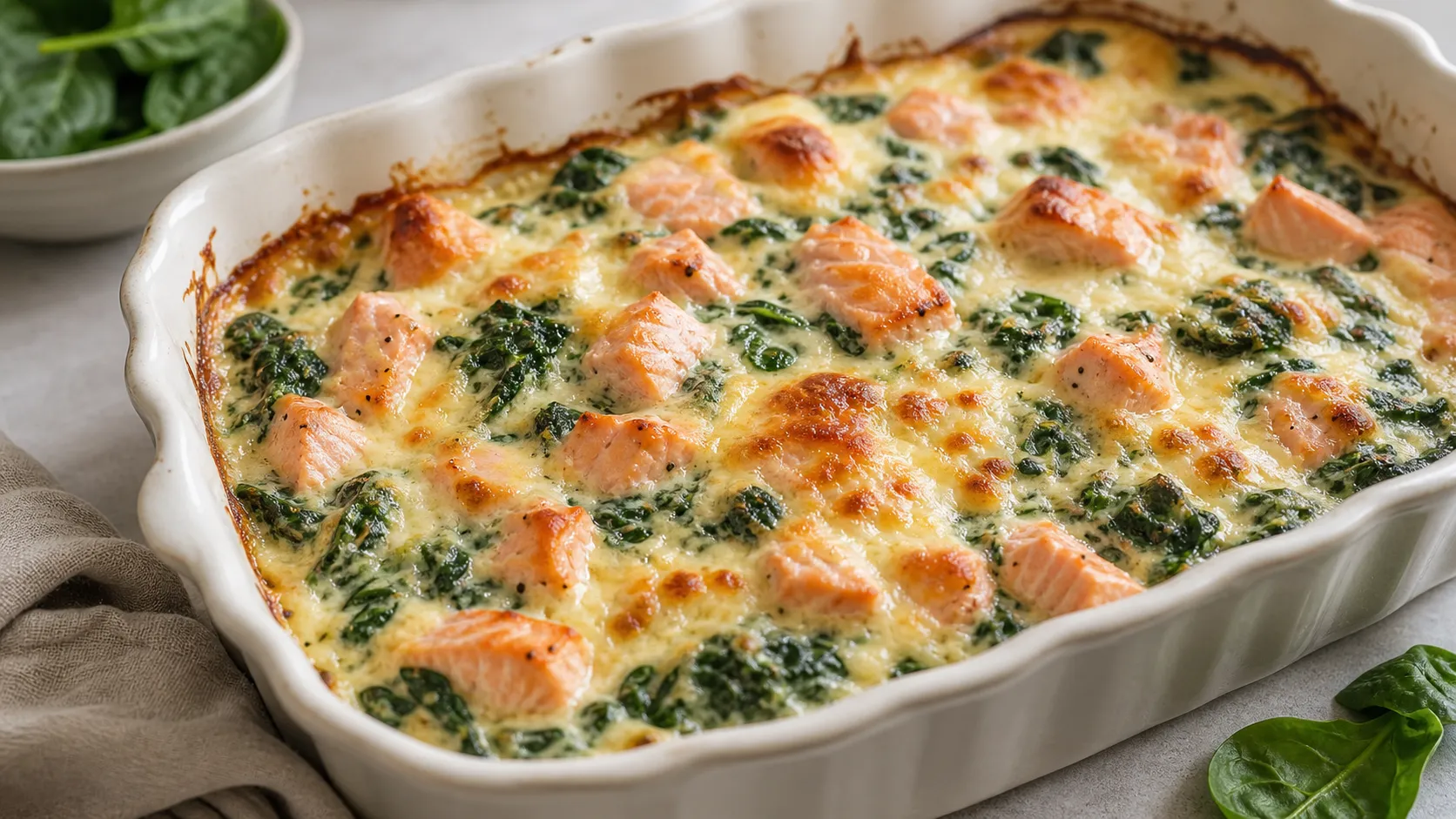
This creamy casserole uses frozen salmon fillet that you can cube and use straight away. Fresh salmon works just as well. Baby spinach, cream cheese and grated cheese make a satisfying main dish with only 5 g net carbs per serving, perfect for relaxed weeknight dinners.
Key facts at a glance
- Total time: approx. 35 minutes, with 10 minutes prep and 25 minutes in the oven.
- Approx. 5 g net carbs and 46 g fat per serving.
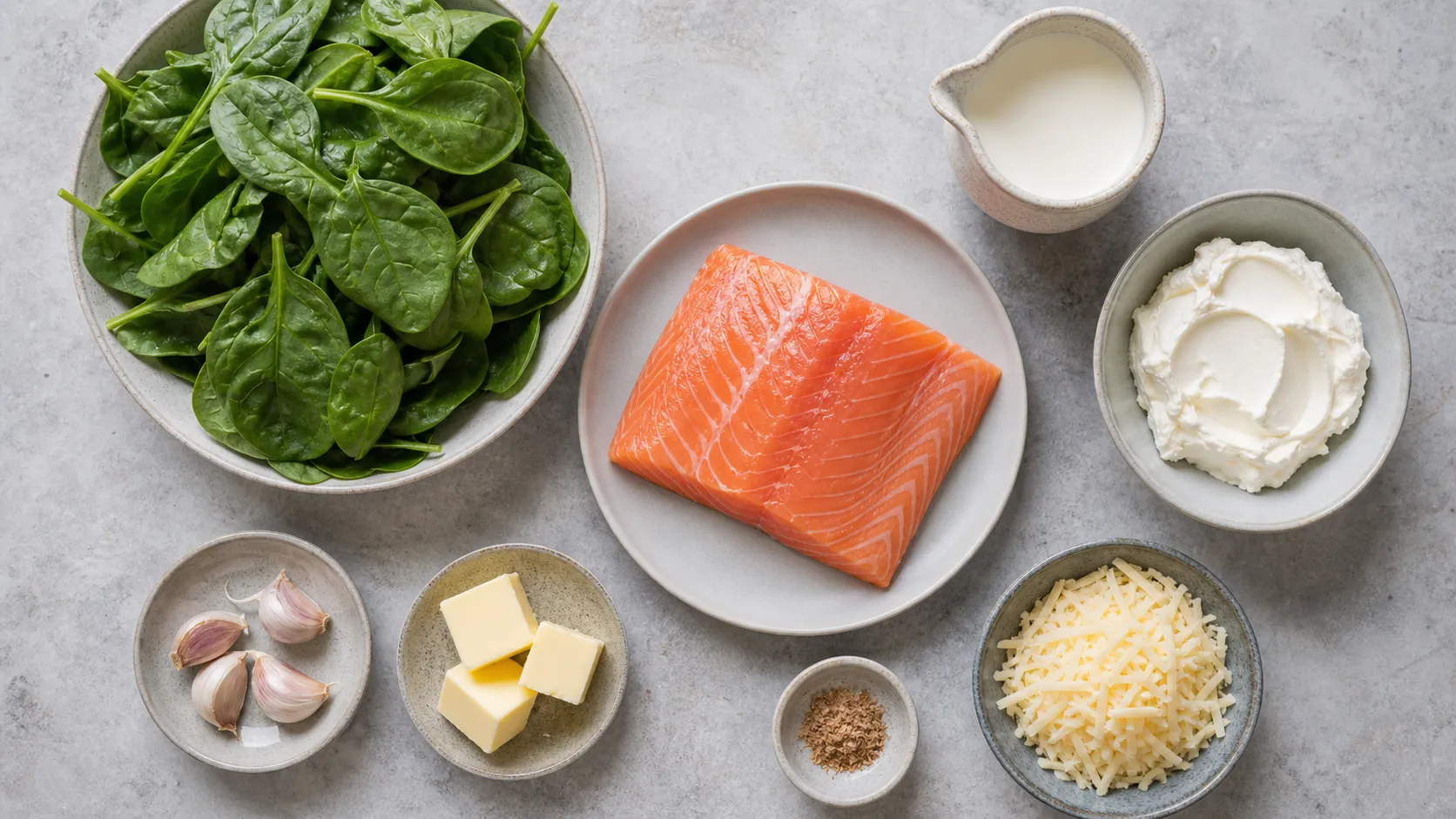
- Ingredients: frozen salmon, baby spinach, cream cheese, cream, grated cheese, garlic.
- Frozen salmon works straight from the freezer, fresh salmon works just as well.
- Makes 4 servings, great for family dinners or meal prep.
Ingredients
Casserole for 4 servings from 600 g frozen salmon
| Amount | Ingredient | Note | ||
|---|---|---|---|---|
| Frozen salmon fillet (or fresh salmon) | cubed | |||
| cubed | ||||
| Baby spinach | - | |||
| Full-fat cream cheese | or full-fat cream cheese | |||
| or full-fat cream cheese | ||||
| Cream | - | |||
| Grated cheese | Gouda or Gruyere | |||
| Gouda or Gruyere | ||||
| Garlic cloves | - | |||
| Butter | - | |||
| Nutmeg | pinch | |||
| pinch | ||||
Frozen salmon or fresh salmon?
Frozen salmon is especially convenient for casseroles. After 30 minutes of thawing at room temperature the fillet cubes cleanly, then bakes gently with the spinach and cream cheese. A little residual chill is not a problem since the casserole needs 25 minutes at 180 C anyway, and the salmon cooks through evenly. Fresh salmon works just as well. Simply cube it and arrange it on the spinach cream cheese base. Baking time is the same. When buying frozen, look for MSC or ASC certification and fillets without ice glaze.
Source: Bundesinstitut für Risikobewertung: Fisch und Fischerzeugnisse
Preparation
-
Prepare the salmon and spinach
approx. 8 minutes600 g Frozen salmon fillet (or fresh salmon) cubed 200 g Baby spinach 2 clove Garlic cloves 20 g Butter Preheat the oven to 180 C on top and bottom heat and lightly grease a baking dish with butter. Thaw the frozen salmon (600 g) for 30 minutes, cut it into roughly 3 cm cubes and season with salt and pepper. Melt the butter (20 g) in a large pan, sweat the 2 chopped garlic cloves, then add the baby spinach (200 g) in batches and let it wilt.
-
Cream cheese sauce
approx. 3 minutes200 g Full-fat cream cheese or full-fat cream cheese 150 ml Cream 150 g Grated cheese Gouda or Gruyere 1 pinch Nutmeg pinch Stir the cream cheese (200 g) and cream (150 ml) into the spinach until the mixture is creamy. Season with a pinch of nutmeg, salt and pepper. The mixture should be creamy but not too runny.
-
Layer and bake
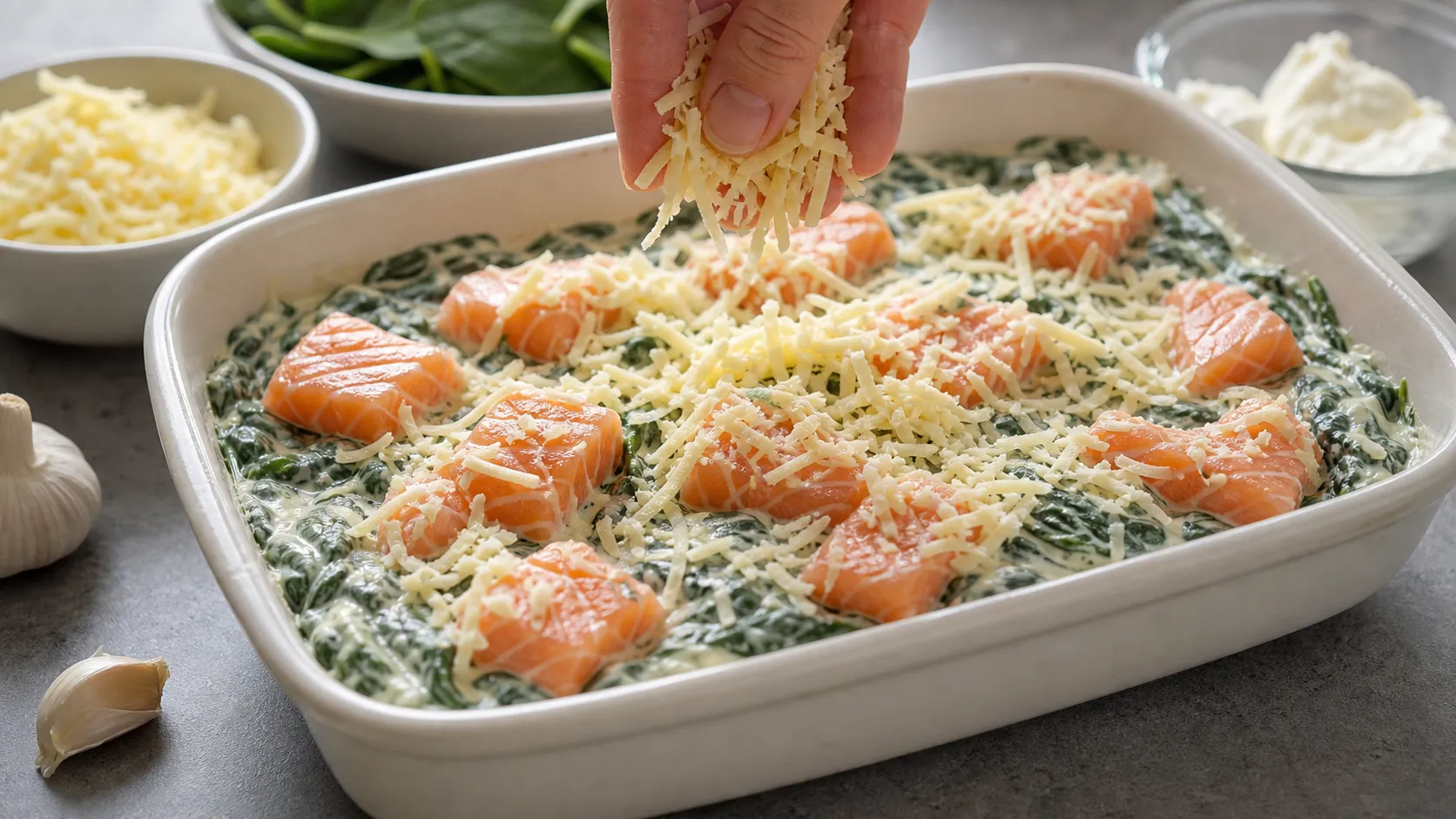
approx. 30 minutesSpread the spinach cream cheese mixture in the baking dish. Press the salmon cubes evenly into the mixture. Sprinkle with grated cheese (150 g). Bake at 180 C for 25 minutes until the cheese is golden brown and bubbling. Let it rest for 5 minutes before serving.
Which tips help with the salmon spinach casserole?
- Sweat the baby spinach only briefly, it keeps cooking in the oven.
- Use cream cheese at room temperature so it blends smoothly with the cream.
- Lightly grease the baking dish so the cheese does not stick.
- Bake at 180 C on conventional top and bottom heat, fan heat dries it out.
- Let the casserole rest for 5 minutes before serving so it sets.
Why this salmon spinach casserole fits keto
Full-fat cream cheese delivers about 34 g fat and 3 g carbs per 100 g, which is very keto friendly. Baby spinach has only 1 g net carbs per 100 g and is one of the most micronutrient-dense vegetables (magnesium, iron, folate). With 400 g of salmon split across 4 servings and 150 g grated cheese, you get a casserole that is high in protein and fat while staying very low in carbs. Classic casseroles with pasta or potatoes come in at 30 to 50 g carbs per serving, while this keto version stays at 5 g.
Source: FDDB – Full-fat cream cheese
Baby spinach for your keto mineral balance
100 g of baby spinach provides about 80 mg magnesium, 560 mg potassium and 2.7 mg iron. On keto your body loses more minerals through the kidneys, so spinach helps balance things out and can ease symptoms like the keto flu.
How to serve and vary the casserole
Serve straight from the baking dish with a simple green salad. In my experience it keeps in the fridge for 3 days and reheats well, which makes it great for meal prep.
Cheese variations
Instead of standard Gouda, mozzarella (mild), Gruyere (savoury), cheddar (sharp) or alpine cheese all work well. Mixing two varieties adds more depth of flavour.
Nutrition values
| Nutrient | Per 100 g | Per serving | Keto context |
|---|---|---|---|
| Calories | approx. 200 kcal | approx. 615 kcal | A complete family-style main dish. |
| A complete family-style main dish. | |||
| Fat | approx. 15 g | approx. 46 g | Approx. 68% of calories from fat, from cream cheese, cheese and salmon. |
| Approx. 68% of calories from fat, from cream cheese, cheese and salmon. | |||
| Net carbs | approx. 1.6 g | approx. 5 g | From cream cheese, spinach and garlic. |
| From cream cheese, spinach and garlic. | |||
| Sugar | approx. 1.2 g | approx. 3.5 g | Lactose from cream cheese and cream. |
| Lactose from cream cheese and cream. | |||
| Protein | approx. 14 g | approx. 44 g | Salmon plus grated cheese. |
| Salmon plus grated cheese. | |||
| Salt | approx. 0.5 g | approx. 1.5 g | From cheese and added salt. |
| From cheese and added salt. | |||
Note: Nutrition values are estimated averages per 100 g and per serving and may vary depending on ingredients, brands, portion size, and preparation. They do not replace individual nutrition or medical advice.
FAQ
Can I use fresh salmon instead?
Yes. Fresh salmon works just as well. Cube it and arrange it on the spinach cream cheese base, with the same baking time (25 minutes at 180 C).
Do I have to fully thaw frozen salmon?
No. 30 minutes of thawing at room temperature is enough to cube the salmon. A little residual chill is fine because the longer baking time of the casserole evens it out.
Can I use frozen spinach?
Yes. Thaw 300 g of frozen spinach (portioned leaves), squeeze it well and use it like baby spinach. Because of the higher water content, reduce the cream to 80 ml.
How long does the casserole keep?
3 days in the fridge. To reheat, warm individual portions for 5 minutes at 160 C in the oven or briefly in the microwave.