Keto Paskha - Quark Dessert with Almonds and Vanilla
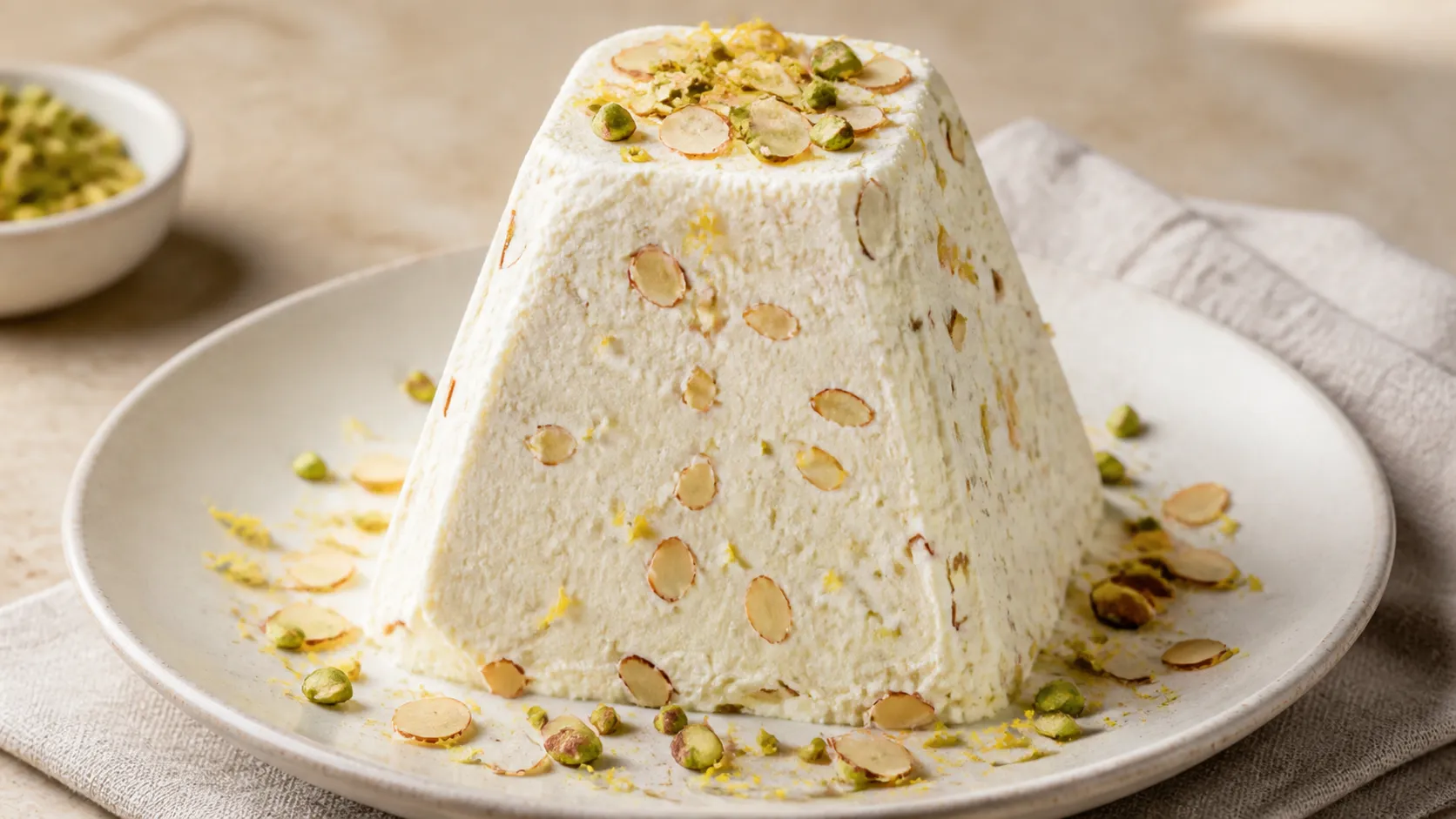
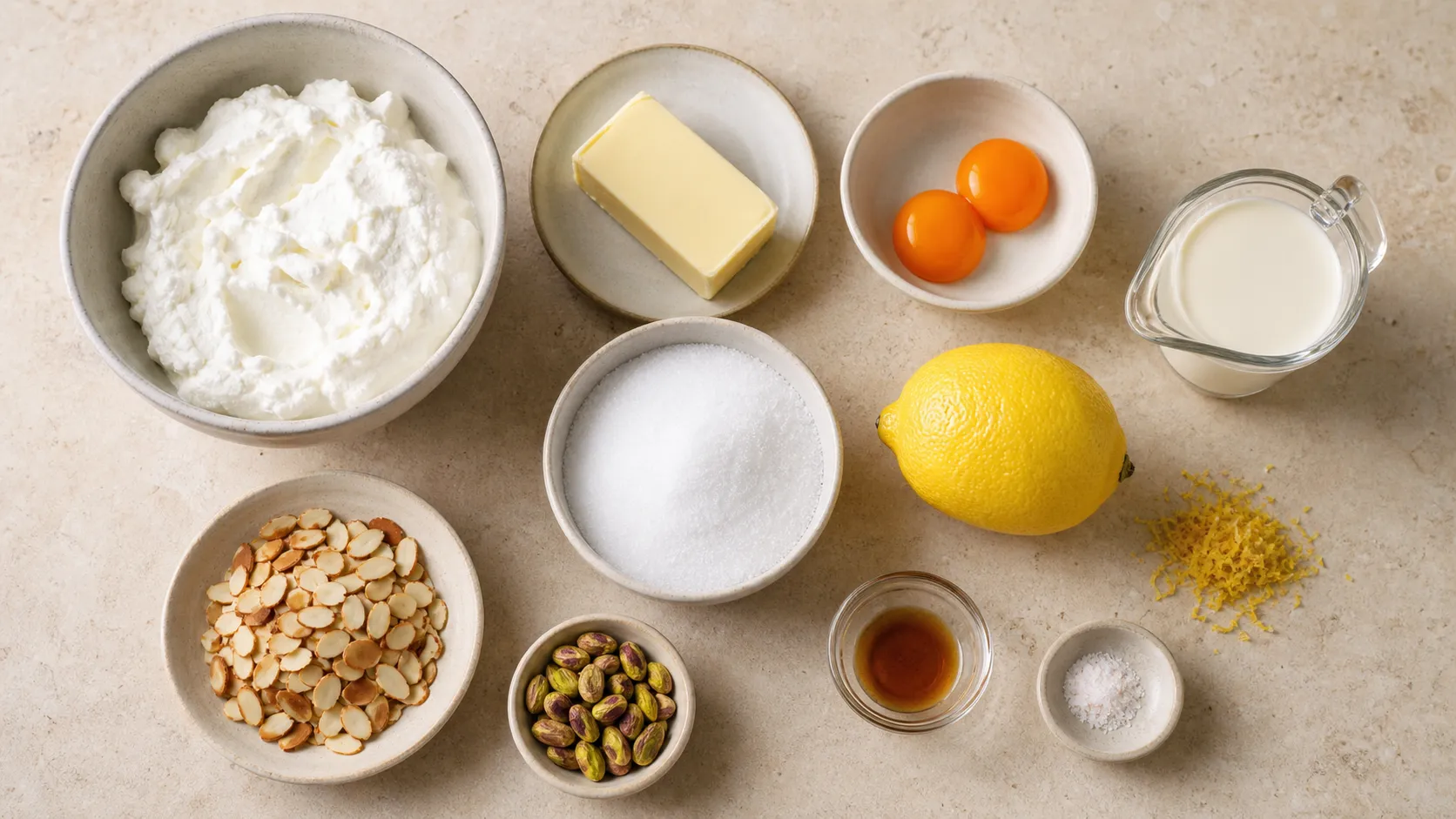
Paskha is the Eastern European quark dessert for holidays: a mixture of quark, butter and egg yolk that drains overnight in a mold and is then turned out. Candied fruit and raisins are dropped in this keto version - replaced by toasted almonds, pistachios and lemon zest.
The key facts at a glance
- Time required: approx. 25 minutes of active work plus 12 hours of chilling.
- Only approx. 2.8 g net carbs and 29 g fat per serving.
- Ingredients: full-fat quark, butter, egg yolk, cream, erythritol, almonds, pistachios, lemon zest.
- Suits guests, because the dessert is completely finished the day before.
Ingredients
Makes about 800 g of cream; a serving of around 100 g is generously measured as a dessert.
| Amount | Ingredient | Note | ||
|---|---|---|---|---|
| full-fat quark 40 % fat in dry matter | as dry as possible, drained beforehand | |||
| as dry as possible, drained beforehand | ||||
| butter | at room temperature | |||
| at room temperature | ||||
| egg yolks | - | |||
| cream | 30 percent fat | |||
| 30 percent fat | ||||
| erythritol | dissolve in the warm cream | |||
| dissolve in the warm cream | ||||
| vanilla extract | approx. 1 tsp | |||
| approx. 1 tsp | ||||
| lemon zest | zest of 1 unwaxed lemon | |||
| zest of 1 unwaxed lemon | ||||
| flaked almonds | toasted dry | |||
| toasted dry | ||||
| pistachios | unsalted, coarsely chopped | |||
| unsalted, coarsely chopped | ||||
| salt | - | |||
How it is made
-
Toast the nuts
approx. 5 minutes60 g flaked almonds toasted dry 30 g pistachios unsalted, coarsely chopped Toast the almonds (60 g) golden brown in a dry pan over medium heat, tip them onto a plate with the pistachios (30 g) and let them cool completely.
-
Cook the egg custard
approx. 5 minutes2 piece egg yolks 100 ml cream 30 percent fat 60 g erythritol dissolve in the warm cream Heat the egg yolks (2 pieces), cream (100 ml) and erythritol (60 g) in a pot while stirring constantly to about 80 degrees Celsius, until the mixture lightly thickens. Do not let it boil, or the yolk curdles.
-
Mix the base
approx. 10 minutes500 g full-fat quark 40 % fat in dry matter as dry as possible, drained beforehand 100 g butter at room temperature 5 ml vanilla extract approx. 1 tsp 5 g lemon zest zest of 1 unwaxed lemon 1 pinch salt Stir the cooled custard smooth with the softened butter (100 g), then work in the full-fat quark (500 g), vanilla extract (5 ml), lemon zest (5 g) and salt (1 pinch).
-
Fill the mold
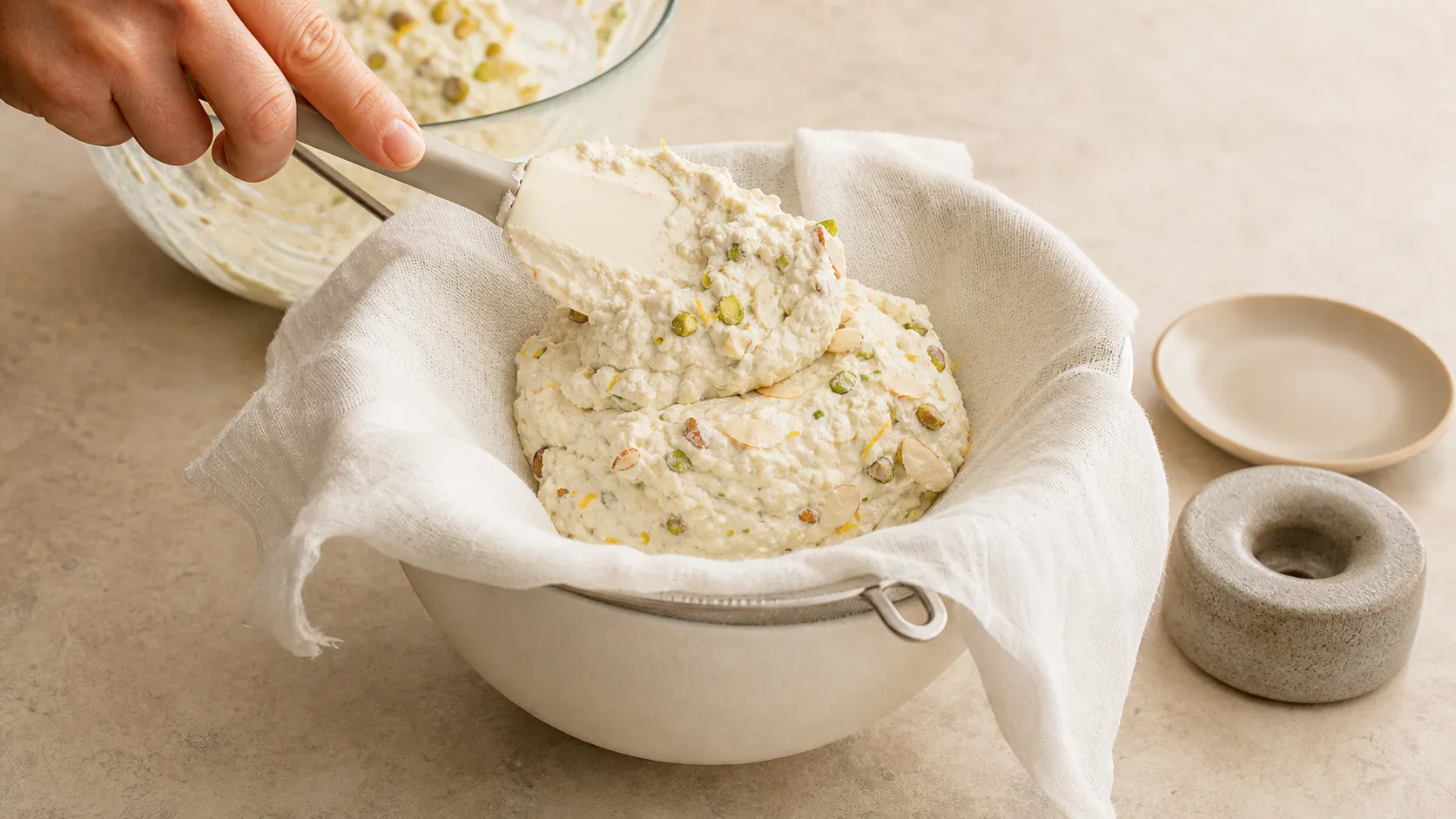
approx. 5 minutesFold in the almonds and pistachios. Line a fine sieve with a double layer of cheesecloth, fill in the mixture, fold the cloth over and weight it with about 500 g. Stand the sieve over a bowl in the fridge.
-
Drain and turn out
12 hoursLet it drain for at least 12 hours, pouring off the whey that collects as you go. To serve, turn it out onto a plate and peel off the cloth.
Which tips help with keto paskha?
- Dissolve the erythritol in the warm cream, or it grits in the cold mixture.
- Heat the egg custard only to about 80 degrees Celsius - above that the yolk curdles.
- Work with the butter at room temperature; cold butter forms lumps in the quark.
- Toast the almonds dry and let them cool completely before folding them in.
- Line the sieve with a double layer of cheesecloth and let it drain over a bowl.
- Weight the mixture with about 500 g, or it will not turn out cleanly.
Why this paskha suits keto well
Alongside quark and butter, the original contains plenty of sugar as well as candied fruit and raisins - so a serving quickly lands at 30 to 40 g carbs, even though the base mixture itself brings barely any. That is exactly where the keto version starts: the base of full-fat quark, butter, egg yolk and cream stays unchanged, the sugar is replaced by erythritol, and instead of candied fruit, toasted almonds and pistachios provide the texture. What remains per serving is approx. 2.8 g net carbs at 29 g fat and 8 g protein. Draining overnight lowers the carb share further, because part of the milk sugar runs off with the whey. Nutrition values for the individual ingredients can be checked in the FDDB nutrition database.
Source: FDDB nutrition database
Why erythritol and how much of it
Erythritol is a sugar alcohol that the body excretes over 90 percent unchanged in urine, so it supplies practically no digestible carbs. Its sweetening power is around 70 percent that of table sugar, which is why 60 g stands here where the original would have about 45 g of sugar. In a cold, fatty mixture the handling is the critical point: crystalline erythritol barely dissolves in quark and butter and later grits between the teeth. That is why it is dissolved here in the warm egg yolk and cream custard before it goes into the cold mixture. If you only have crystalline erythritol, grind it to a powder in a blender first.
Source: German Federal Institute for Risk Assessment - sweeteners
Keeping net carbs predictable
The 2.8 g per serving come from the milk sugar in the quark and cream (approx. 2.2 g) and from the almonds and pistachios (approx. 0.6 g). Erythritol is not counted. Doubling the nuts takes you to around 3.4 g - so the lever is small. Replacing the cream with more butter would have considerably more effect, but it makes the mixture firmer and less creamy.
How do I serve and vary the paskha?
Traditionally paskha is pressed in a pyramid-shaped wooden mold and served turned out; a fine sieve with cheesecloth does the same job, and a flowerpot with a drainage hole comes closest to the classic shape. A few fresh berries and a spoonful of sour cream suit it. In practice the weighting is the most important step: without weight the mixture stays too soft and cannot be turned out cleanly. A can on a plate is entirely enough as a weight.
Meal prep, storing and serving
Paskha is a dessert that demands preparation and is therefore ideal for guests: the mixture has to drain for at least 12 hours, but afterwards it keeps for 4 days in the fridge and becomes firmer and more aromatic along the way. To serve, take it out of the cold 15 minutes beforehand, or it tastes flat. Freezing does not work well - after thawing the butter visibly separates from the quark mixture and the texture turns grainy.
Variation without egg yolk
Without egg yolk the paskha turns paler and somewhat less creamy, but it works: bring the cream to a brief boil with the erythritol, let it cool and stir it straight into the butter and quark. The mixture then needs about 2 hours longer to drain, because the binding egg yolk is missing. If you want more structure instead, replace 50 g of the quark with mascarpone.
Nutrition values
| Nutrient | Per 100 g | Per serving | Keto context |
|---|---|---|---|
| Calories | approx. 319 kcal | approx. 315 kcal | Dense for a dessert; a serving of around 100 g is deliberately kept small. |
| Dense for a dessert; a serving of around 100 g is deliberately kept small. | |||
| Fat | approx. 29 g | approx. 29 g | Very high and typically keto; from butter, full-fat quark, cream and nuts. |
| Very high and typically keto; from butter, full-fat quark, cream and nuts. | |||
| Net carbs | approx. 2.8 g | approx. 2.8 g | Low; classic paskha with sugar and candied fruit sits at 30 to 40 g. |
| Low; classic paskha with sugar and candied fruit sits at 30 to 40 g. | |||
| Sugar | approx. 1.9 g | approx. 1.9 g | Exclusively milk sugar; erythritol does not count as digestible sugar. |
| Exclusively milk sugar; erythritol does not count as digestible sugar. | |||
| Protein | approx. 8 g | approx. 8 g | Considerable for a dessert - the quark carries the main share. |
| Considerable for a dessert - the quark carries the main share. | |||
| Salt | approx. 0.1 g | approx. 0.1 g | Very low; the pinch of salt only rounds off the flavor. |
| Very low; the pinch of salt only rounds off the flavor. | |||
Note: Nutrition values are estimated averages per 100 g and per serving and may vary depending on ingredients, brands, portion size, and preparation. They do not replace individual nutrition or medical advice.
FAQ
Is quark unproblematic on keto in this quantity?
In this form, yes. 500 g of full-fat quark brings around 15 g carbs, which spread over eight servings is about 1.9 g each. On top of that, part of the milk sugar runs off with the whey during draining, so the actual figure tends to be lower.
Can I replace the erythritol with another sweetener?
Yes. Xylitol sweetens similarly but supplies digestible carbs and is toxic to dogs. Erythritol and stevia blends work well but need only about half the quantity. Liquid sweeteners make the mixture softer, which extends the draining time.
Does the paskha really have to drain overnight?
For the classic shape, yes. After 4 hours it is edible but still too soft to turn out. If you are short of time, simply serve it as a cream in a glass - nothing changes in flavor, only the consistency stays spoonably soft.
Does this dessert suit weight loss on keto?
At 2.8 g net carbs it will not disturb ketosis, but 315 kcal per serving is a lot for a dessert. As a replacement for a small meal it works well; as an addition after a full dinner it adds up fast.