Keto Lamb Shank with Rosemary, Garlic and Red Wine
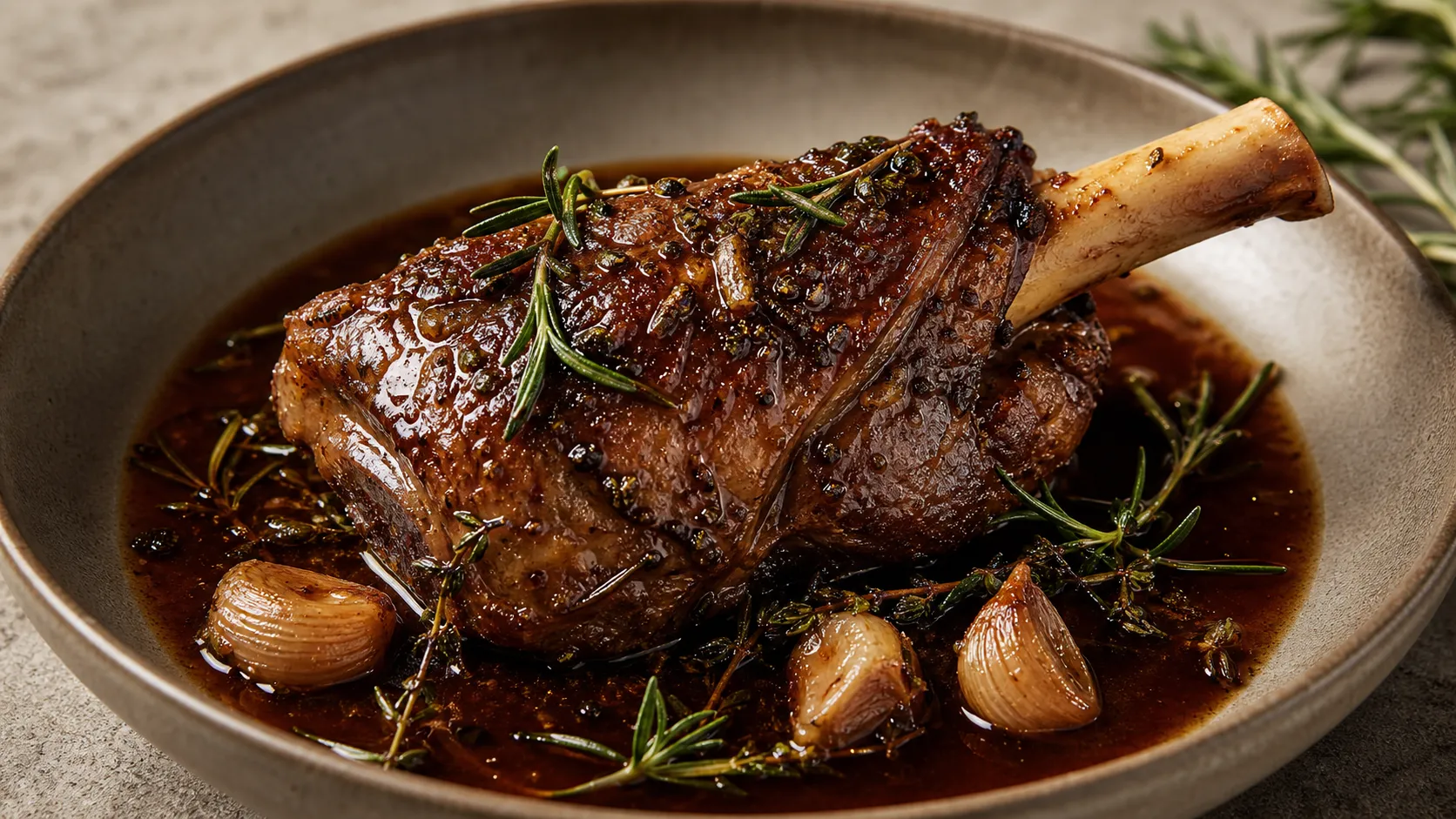
A braised lamb shank is a weekend project: 2 hours of braising, 10 minutes of prep. By the end, the meat falls off the bone and carries a deep, complex rosemary-garlic note. The red wine in the braising liquid caramelizes as it reduces and yields a natural jus without any thickener. 55 g of protein per shank.
Key facts at a glance
- Total time: approx. 2 hours 10 minutes - 10 minutes prep, 2 hours braising.
- Approx. 9 g net carbs and 55 g fat per serving.
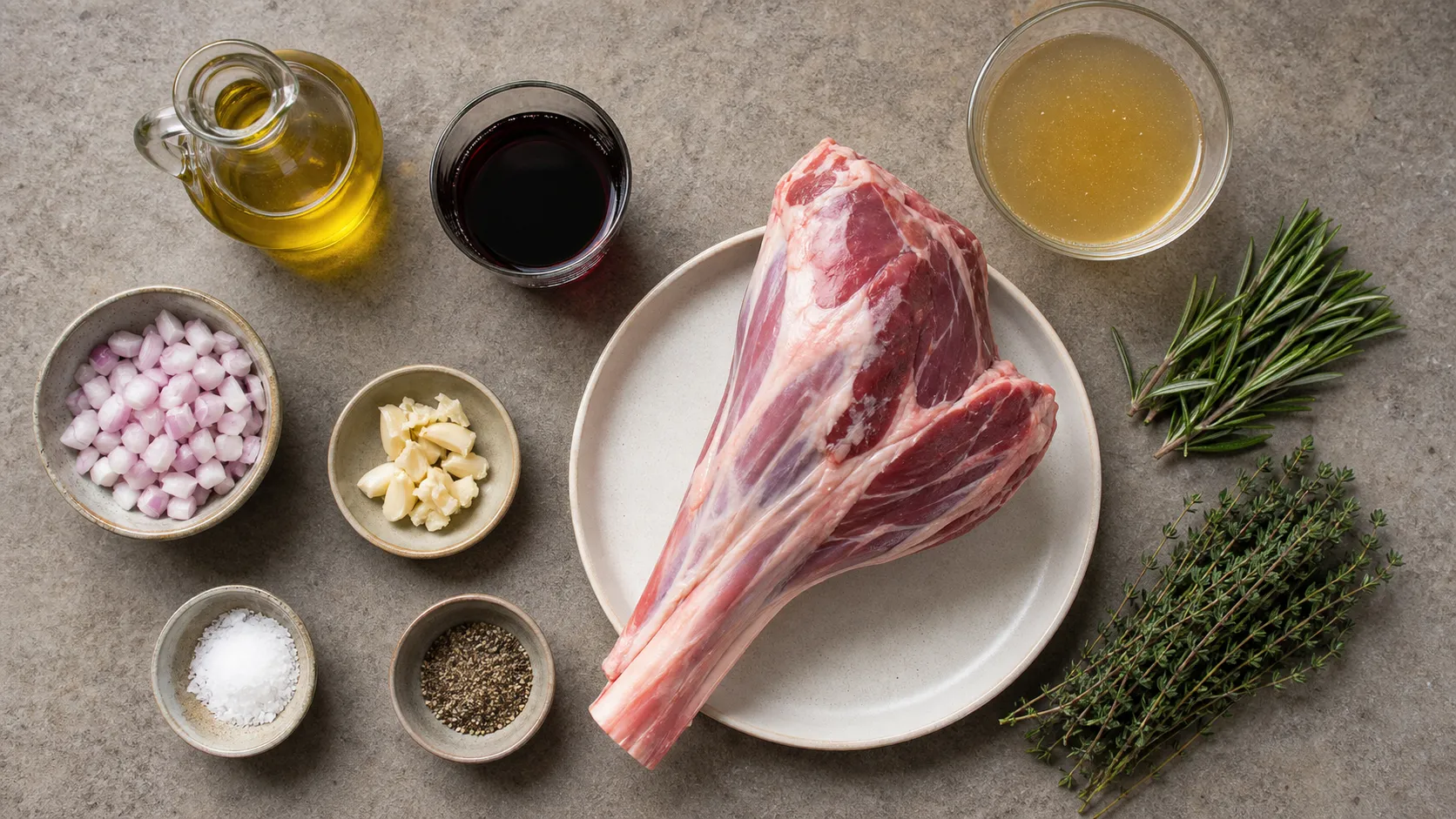
- Ingredients: lamb shank, rosemary, garlic, red wine, lamb stock, shallots, olive oil.
- Only 10 minutes of active cooking - the oven does the rest.
Ingredients
One serving is one whole lamb shank with approx. 100 ml of jus - a complete keto dinner.
| Amount | Ingredient | Note | ||
|---|---|---|---|---|
| Lamb shank (with bone) | - | |||
| Olive oil | approx. 2 tbsp | |||
| approx. 2 tbsp | ||||
| Shallots (coarsely diced) | - | |||
| Garlic cloves | crushed | |||
| crushed | ||||
| Red wine (dry) | - | |||
| Lamb stock (or chicken broth) | - | |||
| Fresh rosemary | 2 sprigs | |||
| 2 sprigs | ||||
| Fresh thyme | 2 sprigs | |||
| 2 sprigs | ||||
| Salt | to taste | |||
| to taste | ||||
| Pepper | to taste | |||
| to taste | ||||
Preparation
-
Sear and build the braising base
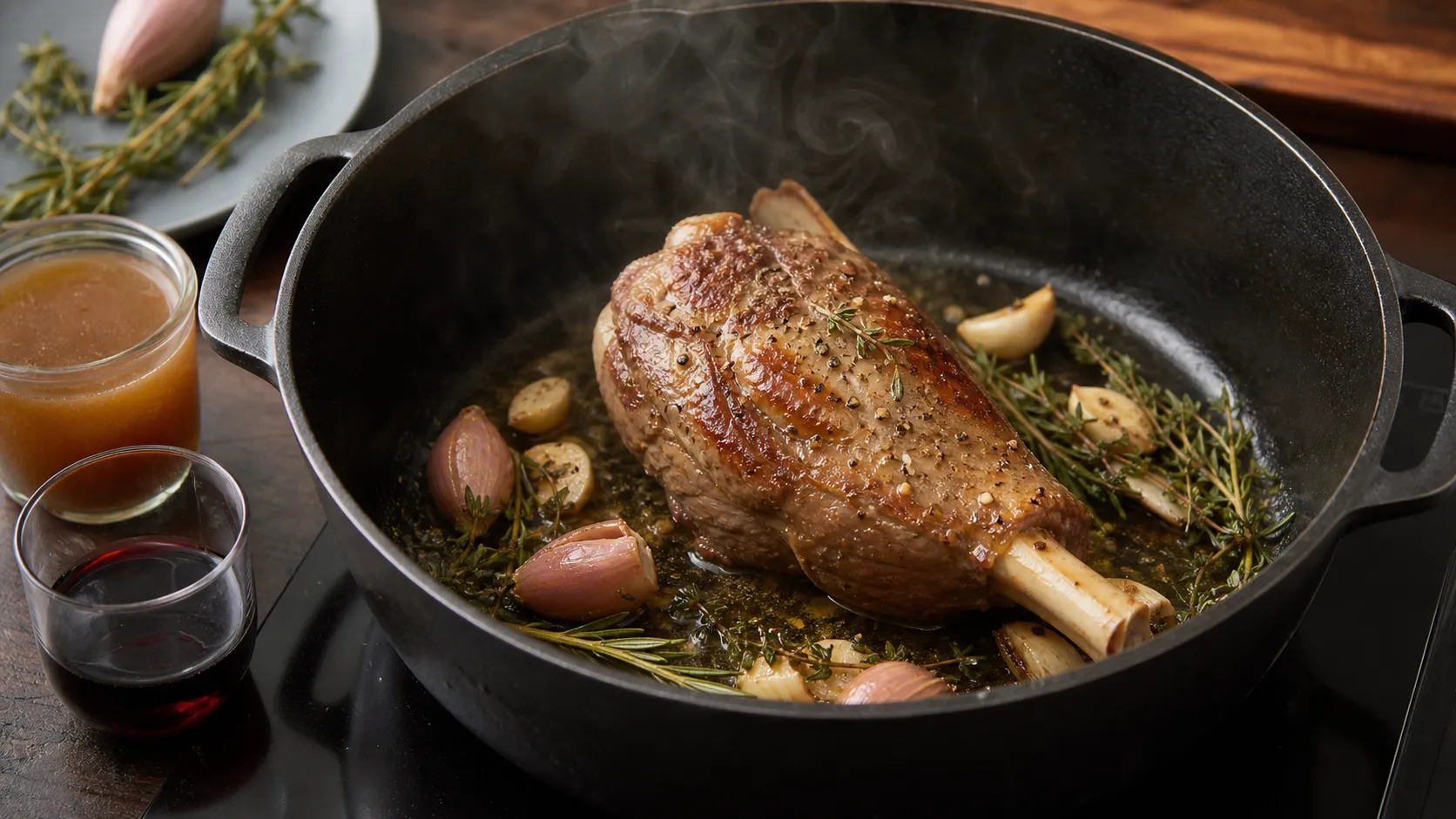
approx. 10 minutes500 g Lamb shank (with bone) 30 ml Olive oil approx. 2 tbsp 2 Stück Shallots (coarsely diced) 4 Zehe Garlic cloves crushed 100 ml Red wine (dry) 150 ml Lamb stock (or chicken broth) 0.5 TL Salt to taste 0.3 TL Pepper to taste Preheat the oven to 160 °C (320 °F). Season the lamb shank (500 g) generously with salt and pepper all over. Heat olive oil (2 tbsp) in a roaster over high heat. Sear the shank on all sides (including the ends near the bone) for 3-4 minutes - do not skip any side. Remove. In the same pot, sweat shallots (2) and 4 garlic cloves for 2 minutes. Deglaze with red wine (100 ml) and reduce hard for 1 minute. Pour in lamb stock (150 ml).
-
Braise in the oven
approx. 120 minutes10 g Fresh rosemary 2 sprigs 10 g Fresh thyme 2 sprigs Return the lamb shank to the roaster, add rosemary (2 sprigs) and thyme (2 sprigs). Seal the roaster tightly with a lid or double-layered foil. Place in the preheated oven at 160 °C (320 °F) for 2 hours. After 1.5 hours, check briefly: if the stock has nearly evaporated, add 50 ml of water or broth.
-
Reduce the jus and plate
approx. 5 minutesCarefully lift the lamb shank out of the roaster and keep it warm on a plate. Strain the stock through a sieve into a small saucepan. Over medium-high heat, reduce for 5 minutes until the jus thickens slightly. Season with salt and pepper. Plate the shank on a deep dish and spoon the jus generously over it.
Which tips help with the keto lamb shank?
- Bring the shank to room temperature before searing - cold meat braises unevenly.
- Do not move the shank while searing - 3-4 minutes per side without disturbing for a proper crust.
- Cover the roaster with a tight-fitting lid or foil so the liquid does not evaporate.
- Check doneness after 1.5 hours: test at the bone - when the meat lifts easily, it is done.
- Strain the jus through a sieve before serving for a clear, elegant sauce.
Why lamb shank works for keto
One lamb shank (approx. 500 g raw with bone) yields about 215 g of meat after braising. Cooked lamb contains approx. 25 g protein and approx. 10 g fat per 100 g. 215 g of lamb delivers approx. 54 g protein and 21 g fat. Olive oil (2 tbsp) for searing adds approx. 28 g fat. Red wine (100 ml) holds approx. 2.5 g carbs (almost all residual sugar, which mostly cooks off). Shallots (50 g) contribute approx. 4 g carbs. Garlic (4 cloves, 20 g) approx. 4 g carbs. Lamb stock (150 ml) approx. 1 g carbs. Total: approx. 55 g protein, 55 g fat, 9 g net carbs, approx. 750 kcal.
Source: USDA FoodData Central - Lamb, shank, cooked, braised , FDDB Nutrition Database - Lamb
Lamb: protein, iron and zinc for keto
Per 100 g, lamb provides approx. 2.7 mg of iron (heme iron, well absorbed) and approx. 4.5 mg of zinc - two minerals that can run low on a low-grain keto diet. Lamb is also rich in vitamin B12 (approx. 2.6 µg/100 g), which matters for nerve health.
Braising: the best method for lamb shank
The lamb shank is a working muscle (the lower leg) full of connective tissue (collagen). Braising at 160 °C (320 °F) for 2 hours converts the collagen into gelatin - that gives the sauce body and the meat a melting texture. Too short and the meat stays tough, too long and it dries out. It is perfect when it lifts off the bone with a spatula.
How do I serve and vary the lamb shank?
Plate the lamb shank on a deep dish, strain the jus and spoon it generously over the meat. Steamed broccoli or cauliflower puree make good sides. From my own kitchen: lift the shank out of the stock, reduce the stock on the stovetop for 5 minutes and mount it with 10 g of butter - the jus turns silkier.
Meal prep: braise the lamb shank the day before
Braised lamb shank often tastes even better the next day as the flavors settle in. Store it chilled in its stock (3-4 days) and reheat it gently in the liquid. For batch cooking: braise 2-3 shanks together in one roaster - same cooking time.
Variation with veal shank or beef shank
Veal shank (similar size): 1.5 hours at 170 °C (340 °F) - milder in flavor than lamb. Beef shank (approx. 700 g): 3-4 hours at 150 °C (300 °F) - bolder in flavor. Both pair well with the rosemary-garlic braise.
Nutrition values
| Nutrient | Per 100 g | Per serving | Keto context |
|---|---|---|---|
| Calories | approx. 214 kcal | approx. 750 kcal | A rich weekend dinner; energy from protein (lamb) and fat (olive oil, lamb fat). |
| A rich weekend dinner; energy from protein (lamb) and fat (olive oil, lamb fat). | |||
| Fat | approx. 15.7 g | approx. 55 g | Saturated and monounsaturated fatty acids from lamb and olive oil. |
| Saturated and monounsaturated fatty acids from lamb and olive oil. | |||
| Net carbs | approx. 2.6 g | approx. 9 g | Moderate for keto; comes from shallots, garlic and residual sugar in the red wine. |
| Moderate for keto; comes from shallots, garlic and residual sugar in the red wine. | |||
| Sugar | approx. 1.4 g | approx. 5 g | Natural sugar from vegetables and residual wine sugar. |
| Natural sugar from vegetables and residual wine sugar. | |||
| Protein | approx. 15.7 g | approx. 55 g | Very high; lamb shank delivers complete protein. |
| Very high; lamb shank delivers complete protein. | |||
| Salt | approx. 0.4 g | approx. 1.4 g | Moderate; controlled by seasoning. |
| Moderate; controlled by seasoning. | |||
Note: Nutrition values are estimated averages per 100 g and per serving and may vary depending on ingredients, brands, portion size, and preparation. They do not replace individual nutrition or medical advice.
FAQ
How large should a lamb shank be for one serving?
A raw lamb shank with the bone weighs about 400-600 g and yields about 180-250 g of meat after braising (40-45 % of the raw weight). For a full keto dinner, one shank (approx. 500 g raw) is just right for one person.
Can I use red wine vinegar or broth instead of red wine?
Red wine vinegar (2 tbsp instead of 100 ml of wine) brings acidity but not the same body to the jus. A better option: skip the wine and raise the total lamb stock to 250 ml, plus 1 tbsp of balsamic. For an alcohol-free version: replace everything with lamb stock and a splash of pomegranate juice (1 tbsp, approx. 3 g carbs).
When is the lamb shank cooked perfectly?
The shank is ready when the meat at the thickest part lifts off the bone effortlessly with a spatula or fork. Internal temperature: approx. 90-95 °C (195-205 °F), the braising window. At an oven temperature of 160 °C (320 °F) that takes about 2 hours - for larger shanks (600 g+), up to 2.5 hours.
Does lamb shank fit a strict keto diet with 20 g of carbs per day?
With 9 g of net carbs, a lamb shank fits even strict keto diets as long as the rest of the day stays under 11 g of carbs combined. The carbs come mainly from shallots, garlic and red wine residues - leaving out the wine drops the carb count to approx. 6 g.