Tea on Keto: The Complete Overview of Allowed and Forbidden Varieties
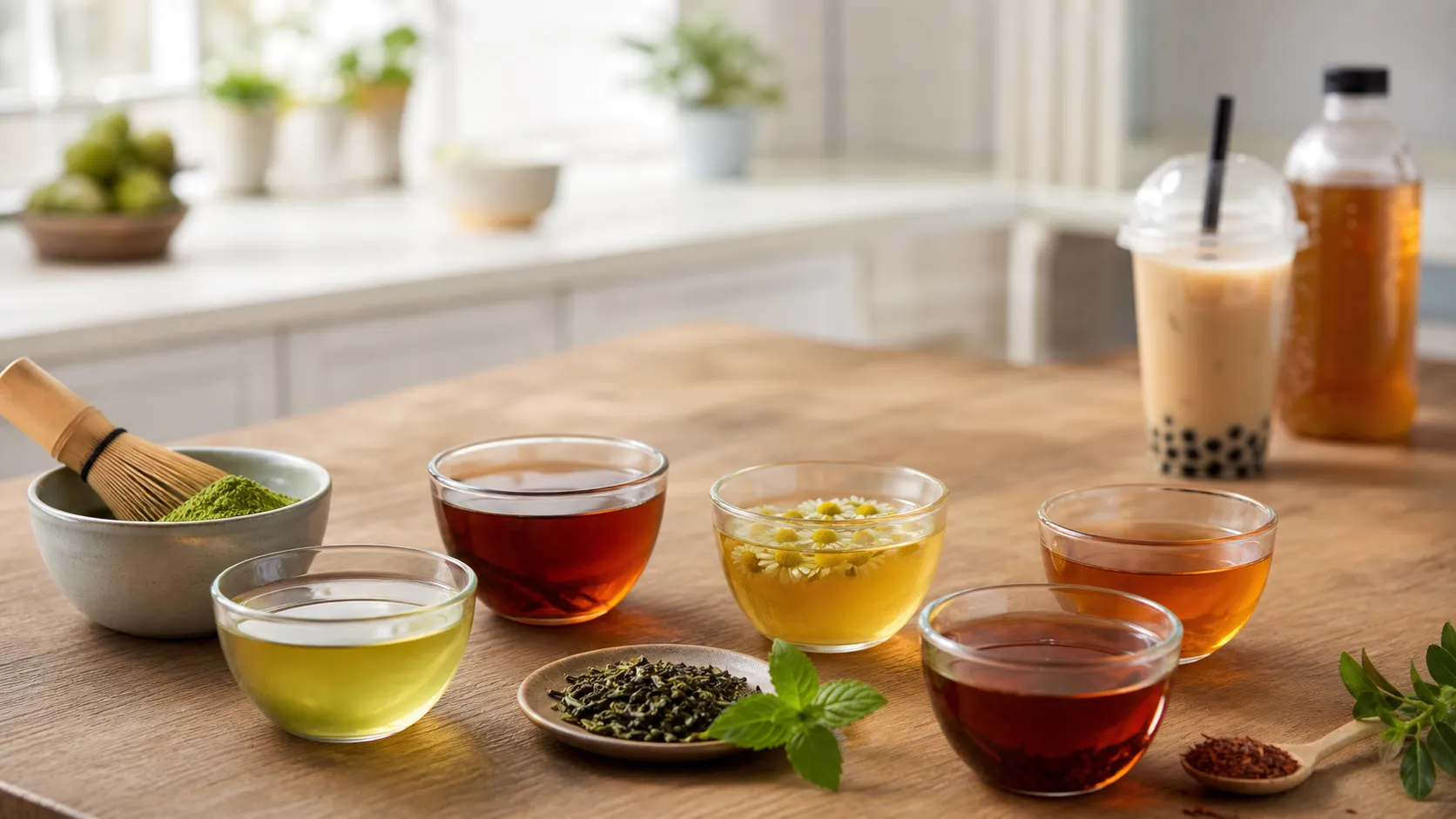
Tea is one of the best drinks for a ketogenic diet. Plain tea contains virtually no carbohydrates and, depending on the variety, supplies valuable polyphenols, catechins, and antioxidants. The rule of thumb is simple: any unsweetened pure tea without additives is keto-friendly. The only problems come from ready-made products, sweetened blends, syrups, and tea drinks from the chiller cabinet. This complete overview shows you which teas you can drink without worry (all true teas and almost all herbal teas), which to treat with caution (hibiscus), and which to avoid entirely (iced tea, bubble tea, chai latte, instant tea). Plus: buying tips, sweetener recommendations, and the specific benefits of tea during the keto adaptation phase.
Key takeaways
- All pure teas (green, black, white, oolong) contain 0 g net carbs per cup and are unreservedly keto-friendly.
- Herbal teas such as peppermint, chamomile, ginger, and rooibos are also nearly carb-free. The exception: hibiscus tea contains up to 7.6 g of carbs per 100 ml and has to be counted.
- Ready-made iced tea, bubble tea, chai latte, and instant tea granules often contain 20 to 50 g of sugar per serving and are off-limits on keto.
- When shopping, check the ingredient list: sugar, maltodextrin, dextrose, and fructose syrup often hide in flavored tea blends.
- Green tea and matcha are especially beneficial because their catechins (EGCG) can support fat oxidation.
Keto-friendly teas at a glance
The good news: the vast majority of pure teas are completely allowed on a ketogenic diet. Whether it's Camellia sinensis, the plant behind green, black, white, and oolong tea, or caffeine-free herbal and fruit infusions, as long as no sugar or carb-containing additives are included, net carbs stay at 0 g per cup (USDA FoodData Central). What matters isn't the tea variety itself but what you add to it, or what the manufacturer has already blended in. Flavored teas often contain licorice root or dried fruits with small amounts of carbs. Pure teas are recognizable by a very short ingredient list, ideally just one entry: the tea leaf or herb itself. With tea bags, don't just look at the front of the box. Check the small print on the back, where hidden sweeteners and carriers often lurk. With organic teas the odds of clean ingredients are higher, but the label is still worth checking.
Green tea
Green tea is the keto classic among teas. One cup (240 ml) contains 0 g net carbs and supplies epigallocatechin gallate (EGCG), which in a study by Venables et al. (Am J Clin Nutr 2008) increased fat oxidation during moderate exercise by 17 percent. Green tea contains moderate amounts of caffeine (25 to 50 mg per cup), enough for a gentle energy lift without the intensity of coffee. The amino acid L-theanine (25 to 60 mg per cup) gently buffers the caffeine effect and supports alert but calm focus. Sencha, Bancha, Gunpowder, Gyokuro, or Long Jing, all varieties are equally keto-friendly. Japanese varieties are often higher quality than mass-market Chinese ones. Brewing rule: 80 to 85 degrees Celsius, not boiling, otherwise the catechins are destroyed. More details at Green Tea on Keto: Nutrition, Benefits, and Preparation.
Black tea
Black tea is produced by fully oxidizing the same leaves as green tea (Camellia sinensis). It contains 0 g net carbs per cup and, at 40 to 70 mg, has the highest caffeine content among teas, about half as much as filter coffee (95 to 120 mg). The theaflavins and thearubigins formed during oxidation make up 1 to 6 percent of dry mass and have been linked in studies to improved cardiovascular health, lower LDL levels, and better endothelial function. Earl Grey, Assam, Darjeeling, English Breakfast, or East Frisian blend, all varieties are allowed on keto as long as you skip the milk and sugar. A splash of cream (about 0.4 g of carbs per tablespoon) or a keto-friendly sweetener like erythritol or stevia work as substitutes. Whole milk, on the other hand, contains 5 g of carbs per 100 ml, which adds up quickly over several cups. More details at Black Tea on Keto: Caffeine, Nutrition, and Preparation.
Matcha
Matcha is ground green tea powder and therefore a special case: you drink the entire leaf, not just the infusion. Per serving (1 to 2 g of powder), matcha delivers about 0.3 g of net carbs, negligible for ketosis. In return, you get an EGCG concentration roughly three times higher than in regular green tea. Caffeine content is 60 to 70 mg per serving, comparable to half a cup of coffee, but it's buffered evenly over 4 to 6 hours by the L-theanine present at the same time. Matcha makes an excellent keto latte with coconut cream or heavy cream. Look for ceremonial or high-grade culinary matcha from Japan (Uji, Nishio, Kagoshima). Cheap Chinese versions often contain more stems and fewer catechins. A 30 g tin of high-quality matcha is enough for 15 to 30 servings. More details at Matcha on Keto: Catechins, Preparation, and What to Look For.
Oolong tea
Oolong is partially oxidized and sits flavor-wise between green and black tea. It contains 0 g of net carbs and supplies both catechins (like green tea) and theaflavins (like black tea). Some research has linked oolong to roughly 10 percent higher fat oxidation during sleep. Caffeine sits at 30 to 50 mg per cup, between green tea and coffee. Oolong is especially varied in flavor, from floral and light (Tie Guan Yin) to roasted and malty (Da Hong Pao, Rou Gui), making it a welcome change in everyday keto life. High-quality oolongs from Taiwan (Dong Ding, Ali Shan, Li Shan) or the Wuyi Mountains in China can be re-steeped 4 to 7 times. More details at Oolong Tea on Keto: Nutrition and Flavor Variety.
White tea
White tea is the least processed type of tea. The young buds and leaves are only withered and dried, never oxidized. The result: 0 g net carbs, a particularly mild and slightly sweet flavor, and a high antioxidant content. Studies show that white tea can have an EGCG content comparable to or even higher than green tea. At 15 to 30 mg per cup, its caffeine content is the lowest among true teas, making white tea a good choice for the afternoon or evening. The most prized varieties are Silver Needle (Bai Hao Yin Zhen, $30 to $80 per 50 g) and White Peony (Bai Mu Dan, $10 to $20 per 50 g). Brew with 75 to 85 degrees Celsius water, no hotter, or the delicate catechins are destroyed. More details at White Tea on Keto: The Mildest of the True Teas.
Peppermint tea
Peppermint tea is caffeine-free, contains 0 g net carbs, and is one of the most popular herbal teas on keto. Menthol and other essential oils (menthone, cineole, limonene) can support digestion and ease bloating, a common issue during the transition to keto. In a placebo-controlled study, peppermint oil reduced appetite scores and improved gastrointestinal motility (Papathanasopoulos et al., Neurogastroenterol Motil 2013). Hot or as a homemade unsweetened iced tea, peppermint is an ideal choice. A caution for reflux (GERD): menthol relaxes the lower esophageal sphincter and can worsen symptoms. In that case, chamomile or fennel are good alternatives. More details at Peppermint Tea on Keto: Digestion, Nutrition, and Recipe Ideas.
Chamomile tea
Chamomile tea is caffeine-free, contains only 0.2 g of net carbs per 100 ml according to USDA data, and is the classic evening tea. The flavonoids apigenin and quercetin it contains have shown anti-inflammatory, calming, and sleep-promoting properties in studies. Apigenin selectively binds the benzodiazepine site of the brain's GABA-A receptors and produces a gentle anxiolytic effect without risk of dependence (PMC2995283). Chamomile is a natural sleep aid, especially during the keto adaptation phase, when sleep disturbances and restlessness can occur. It also helps with stomach complaints during the transition. People allergic to plants in the Asteraceae family (mugwort, ragweed, chrysanthemums) may experience cross-allergies. Egyptian chamomile is considered particularly high quality. More details at Chamomile Tea on Keto: Sleep, Digestion, and Nutrition.
Ginger tea
Ginger tea, ideally brewed from fresh root, contains under 0.5 g of net carbs per cup and is therefore keto-friendly. Ginger contains gingerols and shogaols, which act as anti-inflammatories, stimulate digestion, and can effectively ease nausea. In a meta-analysis of 12 studies, ginger significantly reduced nausea of various causes (PMC4818021). During the adaptation phase, ginger tea can be especially helpful against nausea or keto flu. Use fresh ginger (2 to 3 cm per cup, thinly sliced) or pure organic ginger tea bags without added flavors or sugar. Instant ginger tea powder, by contrast, almost always contains sugar and is not keto-friendly. If you take blood thinners, consult your doctor first. More details at Ginger Tea on Keto: Gingerols, Digestion, and Preparation.
Rooibos tea
Rooibos comes from South Africa, is caffeine-free, and contains 0 g of net carbs. It uniquely supplies aspalathin, a flavonoid found only in rooibos that has shown blood-sugar-lowering properties in animal studies (PMC8001245). Its naturally lightly sweet, woody-malty flavor without any added sugar makes rooibos a good substitute for anyone missing the taste of sweetened drinks. It contains no oxalic acid (unlike true tea), making it more suitable for people prone to kidney stones. Tannins are also present only in very small amounts, which improves tolerability. Rooibos is considered safe even during pregnancy and breastfeeding, and for infants and young children. Green rooibos (unfermented) contains up to ten times more aspalathin than red (fermented) rooibos. More details at Rooibos Tea on Keto: Aspalathin, Benefits, and Nutrition.
Hibiscus tea
Hibiscus tea (also known as karkade) is a caffeine-free infusion of dried hibiscus flowers with a fruity, tart flavor and a striking red color. Unlike most herbal teas, hibiscus tea contains up to 7.6 g of carbohydrates per 100 ml according to USDA data (FDC ID 171946), due to the natural sugars and fruit acids in the flowers. A small cup (150 ml) therefore already delivers around 11 g of carbs, and a regular cup (240 ml) as much as 18 g. That means: hibiscus tea isn't forbidden on keto, but you have to actively count it toward your macros. Strategies: use fewer flowers, brew for less time, dilute the infusion heavily with water. The anthocyanins it contains are potent antioxidants, and hibiscus has been shown to lower blood pressure (PMC7146259). More details at Hibiscus Tea on Keto: Carbs, Anthocyanins, and Correct Dosing.
Source: USDA FoodData Central – Hibiscus Tea, brewed (FDC ID 171946)
Teas and tea drinks to avoid on keto
It isn't the tea itself that's the problem. It's what manufacturers make of it. The following products masquerade as tea but are essentially liquid sugar bombs. A single serving can blow your entire daily carb budget, sometimes twice or three times over. The industry has managed to turn originally healthy beverages into candy by adding huge amounts of sugar, syrup, maltodextrin, and artificial flavors, leaving only the name to identify them as tea. Important to understand: even products labeled less sugar, light, or seemingly healthy (detox tea, slim tea) often contain substantial amounts of carbs. The following four categories are strictly to be avoided on keto: chai latte from cafés, ready-made iced tea from the chiller, bubble tea, and instant tea granules.
Chai latte
A chai latte from a café (Starbucks, Costa, Tchibo) or as a ready-made blend (chai powder, chai concentrate) typically contains 20 to 35 g of sugar per cup (300 ml). The spices themselves, cinnamon, cardamom, ginger, cloves, and black pepper, are all keto-friendly and supply valuable polyphenols. The added sugar (often 4 to 6 teaspoons) and milk (5 g carbs per 100 ml) turn the drink into a keto-killer. Alternative: brew chai spices (1 cinnamon stick, 2 cardamom pods, 2 cm fresh ginger, 3 cloves) in water, add black tea or rooibos, swap the milk for coconut cream or heavy cream, and sweeten with erythritol. The result is an authentic chai with under 2 g of carbs. More details at Chai Latte on Keto: Why the Ready-Made Version Is Off-Limits.
Ready-made iced tea
Commercial iced tea contains 7 to 9 g of sugar per 100 ml according to manufacturer data, more than some sodas. A 500 ml bottle of the common brands (Lipton, Pfanner, Nestea) therefore delivers 35 to 45 g of sugar, equivalent to 12 to 15 sugar cubes. That blows your entire daily keto carb budget in a single drink. Even versions labeled less sugar often still contain 4 to 5 g per 100 ml. The better alternative: brew black or green tea, let it cool, and add lemon juice and erythritol. It only takes 5 minutes of prep plus chilling time and costs a fraction of the branded product. With fresh mint, lime, or berries (in small amounts), homemade versions stay varied in flavor. More details at Iced Tea on Keto: Sugar Trap and a Keto-Friendly Alternative.
Bubble tea
Bubble tea combines sweetened tea with tapioca pearls (pure starch from the cassava root) or fruit-syrup popping bobas. A standard cup (500 ml) contains 30 to 50 g of sugar. The tapioca pearls alone deliver 20 to 25 g of carbs because they consist of concentrated starch. The added syrups, milk powder, and fruit juices add another 15 to 25 g of sugar. There is no meaningful keto version of this drink in its usual form. Even if you leave out the syrup, the tapioca pearls remain an integral component and therefore carb-heavy. The closest you can get is konjac pearls (glucomannan) with sweetened tea and erythritol, but that's no longer really bubble tea. Skip it entirely. More details at Bubble Tea on Keto: Why It's Not a Good Idea.
Instant tea and tea granules
Instant tea granules consist of 90 to 97 percent sugar or dextrose. The actual tea extract usually makes up less than 3 percent. Even supposedly reduced-calorie versions often contain maltodextrin, which raises blood sugar with a glycemic index of 95 to 110, even more than table sugar (GI 65). A prepared cup with 12 to 15 g of powder delivers 11 to 14 g of carbs, more than two sugar cubes. Reach for real tea bags or loose-leaf tea instead. The time difference is minimal (2 to 3 minutes of brewing), but the keto-compatibility is complete. A pack of organic tea costs $3 to $5 for 20 to 40 bags, around 10 to 25 cents per cup with zero carbs. More details at Instant Tea on Keto: Why Granules Almost Always Fail.
What to look for when buying tea on keto
The most important principle: the shorter the ingredient list, the better. For pure tea there should be only a single ingredient, the tea leaves or herbs themselves. Check the ingredient list: sugar, dextrose, maltodextrin, glucose syrup, and fructose regularly show up in flavored tea blends. Natural flavor can also be a hint at added carrier substances. In herbal tea blends like Winter Magic, Oriental Dream, or Detox Tea, dried fruit pieces and licorice root often hide and contribute small amounts of carbs. Loose vs. bagged: high-quality loose-leaf tea consists of whole leaves and contains more polyphenols than the fannings dust in cheap tea bags. For keto, that makes no difference in your macros, but it matters for added health value. Organic quality: tea is one of those products where organic quality pays off. Conventionally grown tea can contain pesticide residues, especially black tea from outside the EU. Organic seals (EU Organic, USDA Organic, Naturland, Demeter) offer more safety. Watch for marketing traps: products labeled detox tea, keto tea, or fat-burner tea are almost always overpriced standard tea blends with misleading promises. No tea burns fat on its own. Caffeine timing: green tea, black tea, oolong, and matcha contain caffeine. Don't drink caffeinated teas after 2 to 3 p.m. if you're sensitive to caffeine. Choose add-ins deliberately: milk contains lactose (about 5 g of carbs per 100 ml). Use heavy cream instead (under 0.5 g of carbs per splash), coconut cream, or unsweetened almond milk. For sweetening, erythritol or stevia work well.
Frequently asked questions about tea on keto
Can I drink tea with milk on keto? A splash of whole milk (30 ml) contains about 1.5 g of carbs. Acceptable for one cup a day, but it adds up over several. Use heavy cream instead (under 0.5 g of carbs per splash) or unsweetened almond milk (0.3 g of carbs per 100 ml). Will tea with honey kick me out of ketosis? Yes. A teaspoon of honey contains about 6 g of pure carbs (fructose and glucose). Two cups of tea with honey can already eat up a third of your daily budget. Use erythritol or stevia instead. How much tea can I drink per day on keto? There's no upper limit for unsweetened tea on keto, as long as you watch your caffeine intake. EFSA considers up to 400 mg of caffeine per day safe for adults, which equals about 6 to 8 cups of green tea or 5 to 6 cups of black tea. Herbal teas are caffeine-free and can be drunk in unlimited amounts. Is kombucha allowed on keto? Kombucha contains 2 to 7 g of carbs per 100 ml depending on the brand, because the fermentation process doesn't fully break down the sugar. Small amounts can fit if you control the rest of your macros, but it isn't a free pass. Do herbal teas count toward water intake? Yes. Caffeine-free herbal teas (peppermint, chamomile, rooibos) contribute to fluid intake. Even caffeinated tea doesn't appreciably dehydrate at moderate consumption.
Top 5 teas for the keto adaptation phase
- Peppermint tea – soothes the stomach and helps with bloating during the transition
- Chamomile tea – supports sleep, which can be disturbed in the first days of keto
- Ginger tea – combats the nausea some people experience during adaptation
- Green tea – provides gentle caffeine and EGCG for fat burning
- Rooibos tea – caffeine-free and naturally lightly sweet as a stand-in for sugary drinks
| Tea | Net carbs per cup | Caffeine per cup | Keto status |
|---|---|---|---|
| Green tea | 0 g | 25–50 mg | ✅ Allowed |
| Black tea | 0 g | 40–70 mg | ✅ Allowed |
| White tea | 0 g | 15–30 mg | ✅ Allowed |
| Oolong tea | 0 g | 30–50 mg | ✅ Allowed |
| Matcha (1–2 g) | ~0.3 g | 60–70 mg | ✅ Allowed |
| Peppermint tea | 0 g | 0 mg | ✅ Allowed |
| Chamomile tea | 0 g | 0 mg | ✅ Allowed |
| Ginger tea | < 0.5 g | 0 mg | ✅ Allowed |
| Rooibos tea | 0 g | 0 mg | ✅ Allowed |
| Hibiscus tea | ~7.6 g / 100 ml | 0 mg | ⚠️ With caution |
| Chai latte (café) | 20–35 g | 50 mg | ❌ Not allowed |
| Ready-made iced tea (500 ml) | 35–45 g | 15–25 mg | ❌ Not allowed |
| Bubble tea (500 ml) | 30–50 g | varies | ❌ Not allowed |
| Instant tea granules | 12–15 g | varies | ❌ Not allowed |
FAQ
Which tea is best for keto adaptation?
Three teas are especially valuable for the adaptation phase: <strong>peppermint tea</strong> for bloating and digestive issues, <strong>chamomile tea</strong> for better sleep in the first keto weeks, and <strong>ginger tea</strong> for nausea and keto flu. All three are caffeine-free, contain nearly 0 g of carbs, and can be drunk in any amount. Green tea additionally supports fat oxidation.
Which tea has the most antioxidants?
Matcha leads clearly because the entire ground leaf is consumed in water, delivering three times more EGCG than brewed green tea. It's followed by white tea (especially Silver Needle), green tea, oolong, and black tea. Among herbal teas, rooibos (aspalathin) and hibiscus (anthocyanins) are high-quality sources of antioxidants. For maximum effect, drink 3 to 5 cups daily.
Can I drink flavored tea blends on keto?
With caution. Many flavored teas contain licorice root, dried fruits, or sweeteners as carrier ingredients that provide small to moderate amounts of carbs. Always check the ingredient list for sugar, dextrose, maltodextrin, and fructose syrup. Genuine organic flavorings with essential oils (e.g., Earl Grey with bergamot) are keto-friendly. When in doubt, stick to plain tea.