Keto Pumpkin Chicken Curry with Coconut Milk and Spinach
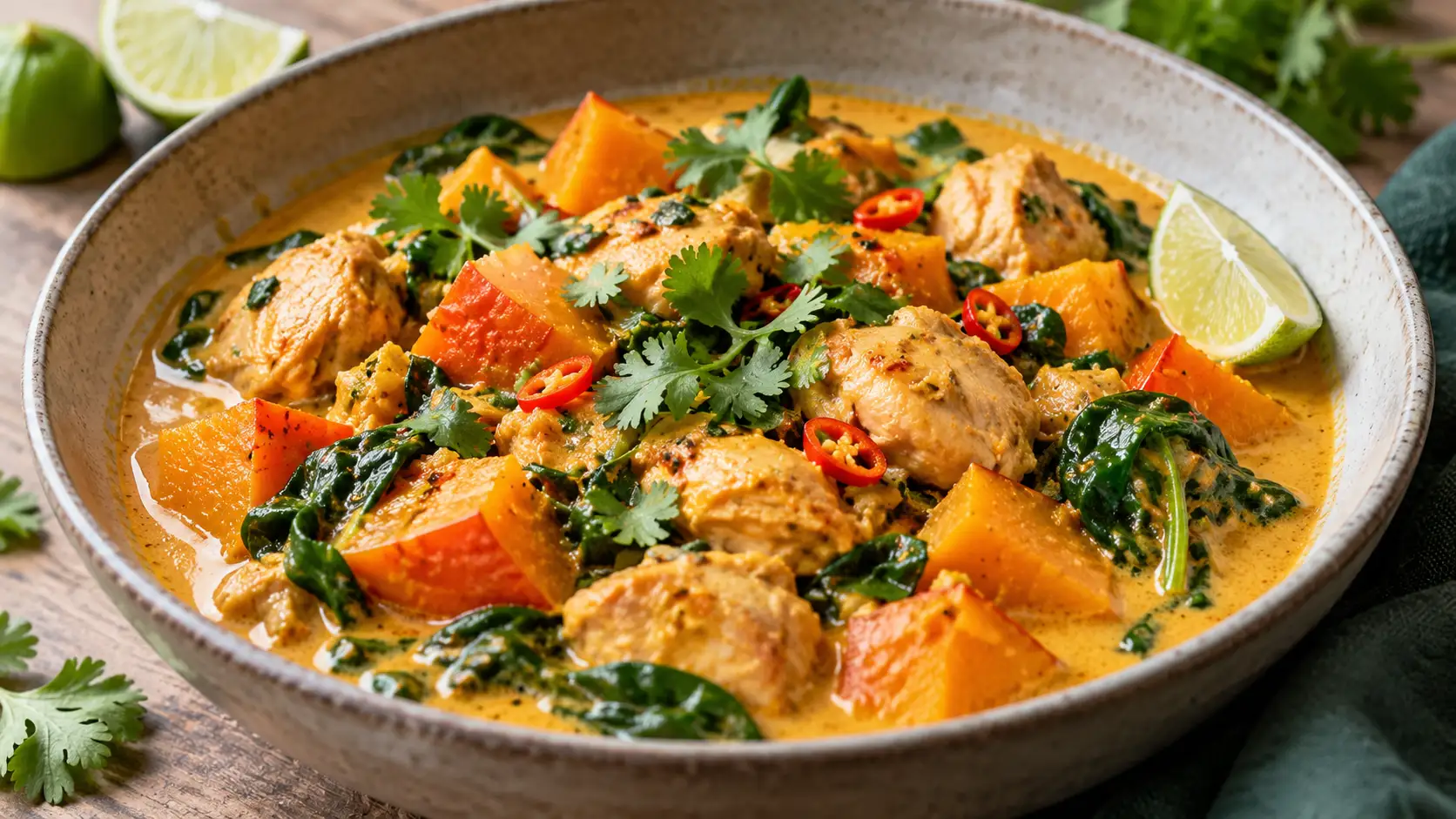
A keto pumpkin curry is one of those dishes where the ketogenic version hardly makes any compromises: coconut milk, chicken thighs and curry paste are naturally rich in fat and low in carbs, and only the rice is left out. Here, Hokkaido pumpkin stands in for the sweet potato of a classic Thai curry and, at 75 g per serving, brings about 3.5 g net carbs - instead of the 15 g the same amount of sweet potato would cost. In total, one serving lands at about 8 g net carbs and 46 g fat. In October, locally grown Hokkaido pumpkin is available everywhere and cheaper than at any other time of year.
Key facts at a glance
- Preparation time: approx. 45 minutes - a warming dinner made in one wok or deep skillet.
- Approx. 8 g net carbs and 46 g fat per serving.
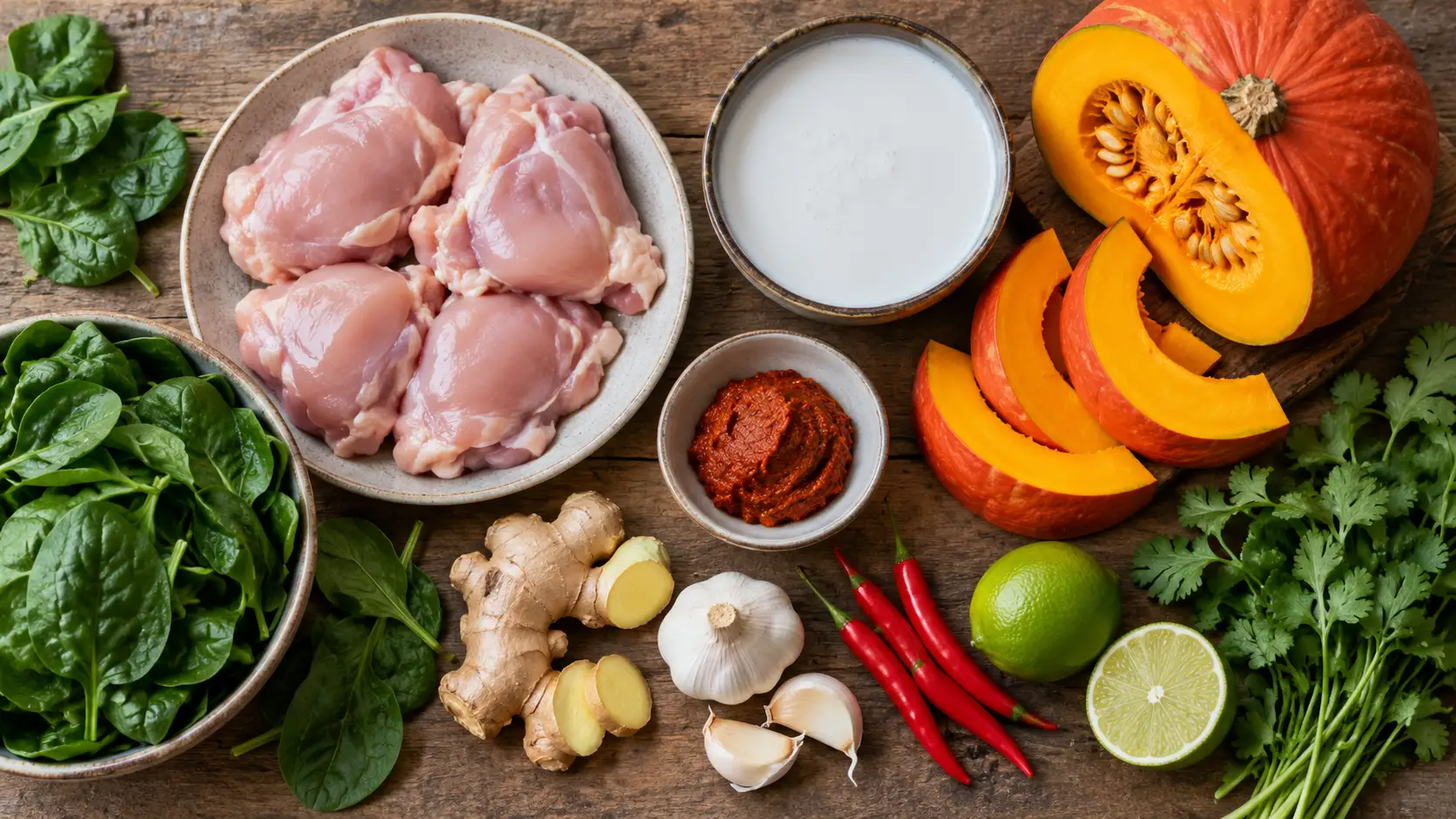
- Ingredients: chicken thighs, Hokkaido pumpkin, coconut milk, red curry paste, ginger, spinach, lime, cilantro.
- Suitable for anyone looking for a filling keto dinner that also works for meal prep.
Ingredients
One serving is a deep bowl with around 350 g of curry, roughly 150 g of chicken, 75 g of pumpkin and sauce.
| Amount | Ingredient | Note | ||
|---|---|---|---|---|
| boneless chicken thighs | skin-on, cut into 3 cm pieces | |||
| skin-on, cut into 3 cm pieces | ||||
| Hokkaido pumpkin | unpeeled, cut into 2 cm cubes | |||
| unpeeled, cut into 2 cm cubes | ||||
| coconut milk | canned, at least 17 % fat | |||
| canned, at least 17 % fat | ||||
| red curry paste | approx. 1.5 tbsp, no added sugar | |||
| approx. 1.5 tbsp, no added sugar | ||||
| coconut oil | approx. 1.5 tbsp | |||
| approx. 1.5 tbsp | ||||
| shallot | 1 small shallot, finely diced | |||
| 1 small shallot, finely diced | ||||
| ginger | fresh, finely grated | |||
| fresh, finely grated | ||||
| garlic cloves | finely chopped | |||
| finely chopped | ||||
| red chili pepper | 1 pepper, seeded and finely chopped | |||
| 1 pepper, seeded and finely chopped | ||||
| spinach | fresh leaf spinach, washed | |||
| fresh leaf spinach, washed | ||||
| lime juice | juice of 1/2 lime | |||
| juice of 1/2 lime | ||||
| fish sauce | approx. 2 tsp | |||
| approx. 2 tsp | ||||
| cilantro | fresh, coarsely chopped, for serving | |||
| fresh, coarsely chopped, for serving | ||||
| salt | adjust the seasoning at the end | |||
| adjust the seasoning at the end | ||||
Preparation
-
Toast the curry paste
approx. 3 minutesDone Amount Icon Ingredient 400 ml coconut milk canned, at least 17 % fat 25 g red curry paste approx. 1.5 tbsp, no added sugar 20 g coconut oil approx. 1.5 tbsp Heat the coconut oil (20 g) in a wok or deep skillet over medium-high heat. Add the red curry paste (25 g) and toast it, stirring, for 2 minutes until it darkens and smells intensely fragrant.
-
Saute the aromatics
approx. 2 minutesDone Amount Icon Ingredient 30 g shallot 1 small shallot, finely diced 15 g ginger fresh, finely grated 2 cloves garlic cloves finely chopped 10 g red chili pepper 1 pepper, seeded and finely chopped Add the finely diced shallot (30 g), the grated ginger (15 g), the chopped garlic cloves (2 cloves) and the chopped chili pepper (10 g) and saute for 2 minutes.
-
Brown the chicken
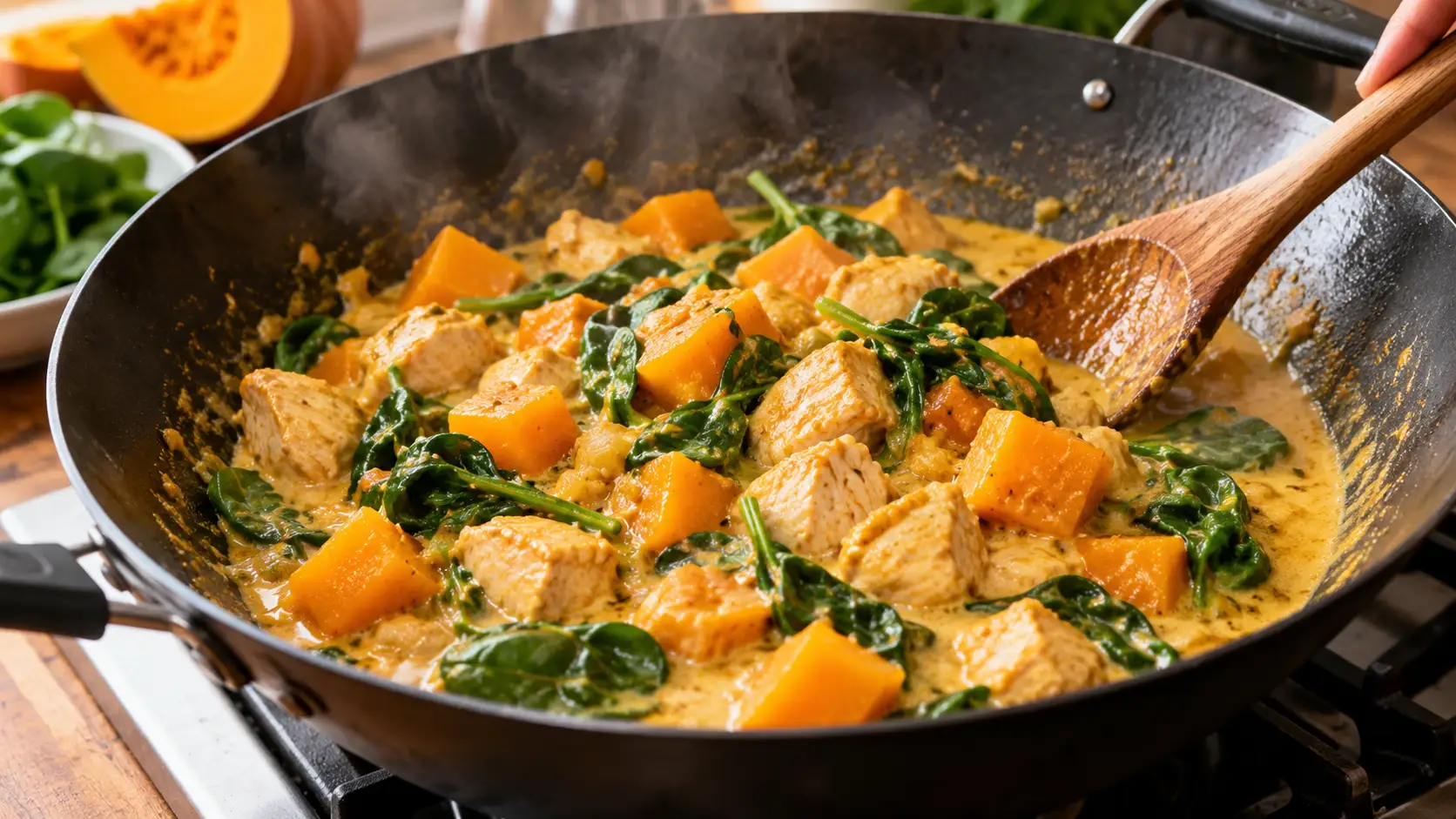
approx. 5 minutesDone Amount Icon Ingredient 600 g boneless chicken thighs skin-on, cut into 3 cm pieces Add the chicken thigh pieces (600 g) and brown them on all sides, turning occasionally, until they have taken on some color on the outside. They do not need to be cooked through yet.
-
Add the pumpkin and coconut milk
approx. 20 minutesDone Amount Icon Ingredient 300 g Hokkaido pumpkin unpeeled, cut into 2 cm cubes Add the unpeeled Hokkaido cubes (300 g) and the coconut milk (400 ml), bring to a boil once, then cover and simmer over low heat until a knife slides into the pumpkin without resistance and the chicken is cooked through.
-
Add the spinach and season
approx. 3 minutesDone Amount Icon Ingredient 150 g spinach fresh leaf spinach, washed 15 ml lime juice juice of 1/2 lime 10 ml fish sauce approx. 2 tsp 0.3 tsp salt adjust the seasoning at the end Stir in the spinach (150 g) and let it wilt for 1 minute. Season to taste with lime juice (15 ml), fish sauce (10 ml) and salt (1/4 tsp).
-
Serve
approx. 2 minutesDone Amount Icon Ingredient 10 g cilantro fresh, coarsely chopped, for serving Ladle the curry into deep bowls and sprinkle with the chopped cilantro (10 g). Serve with a lime wedge if you like.
Which tips help with keto pumpkin curry?
- Toast the curry paste in hot coconut oil for 2 minutes before adding any liquid - that is what makes the flavor.
- Use chicken thighs instead of breast: they stay juicy in the sauce and provide the fat for keto.
- Cut the Hokkaido unpeeled into 2 cm cubes so it cooks evenly and does not fall apart.
- Use full-fat canned coconut milk, not a light version.
- Stir in the spinach only at the end; it needs just one minute.
- Add lime juice and fish sauce only at the end and adjust the seasoning - both lose their freshness when cooked.
Why is this pumpkin curry keto-friendly?
A classic Thai curry with sweet potato and a serving of jasmine rice comes to 60 to 70 g of carbs. This version drops the rice entirely and replaces the sweet potato with Hokkaido pumpkin, which at around 4.5 g of usable carbs per 100 g carries only a third of what sweet potato does. The 300 g of pumpkin in the recipe is split across four servings, so 75 g and therefore about 3.5 g per person. The coconut milk, at 100 ml per serving, adds another 2.5 g, and curry paste, shallot, ginger, garlic and lime together add around 2 g. That puts one serving at about 8 g net carbs - on the high side for a keto dinner, which calls for a frugal day beforehand, but it fits into a plan of 20 to 50 g of carbs. The fat side works out without any help: skin-on chicken thighs and coconut milk deliver 46 g of fat per serving, which is why the curry keeps you full for a long time. If you use chicken breast instead of thighs, you save 10 g of fat and about 100 kcal but lose some juiciness. The nutritional values of the individual ingredients can be looked up in the German Nutrient Database (BLS) and USDA FoodData Central.
Source: Max Rubner Institute – German Nutrient Database (BLS) , USDA FoodData Central
Coconut milk as the fat base
Canned coconut milk with 17 to 20 % fat provides around 18 g of fat and only 2 to 3 g of usable carbs per 100 ml. A large share of that fat consists of medium-chain fatty acids, which the body metabolizes faster than long-chain fats. It is important not to use light coconut milk: it contains more water, binds the sauce less well and shifts the ratio toward the carbs. The Harvard Nutrition Source puts the role of saturated and medium-chain fatty acids in the diet into context.
Source: Harvard T.H. Chan – The Nutrition Source: Coconut Oil
Keeping net carbs predictable
Pumpkin and coconut milk account for three quarters of the carbs. If you count more strictly, use 200 g of Hokkaido and add 150 g of cauliflower florets or diced zucchini - the serving then comes to about 6.5 g without the curry getting any thinner. Ready-made curry paste contains 10 to 15 g of carbs per 100 g depending on the brand, which is negligible at 25 g in the recipe. Still, check the ingredient list of the paste for sugar, as some brands sweeten heavily.
How do I serve and vary the pumpkin curry?
Serve the curry hot in deep bowls with fresh cilantro and a lime wedge; instead of rice, fried cauliflower rice works well, or simply an extra spoonful of sauce. In practice, it makes a real difference to actually toast the curry paste for 2 minutes in hot coconut oil until it darkens and smells fragrant - stirred in raw, it tastes flat and slightly bitter. The Hokkaido cubes stay unpeeled; the skin softens in the coconut milk and keeps the cubes in shape. In October it pays to look around the farmers market: the small Hokkaido pumpkins of 800 g to 1 kg are more aromatic and firmer than the large storage pumpkins that come later in the year.
Meal prep and reheating
The curry is a good meal prep dish and tastes even more rounded on the second day. Without spinach and cilantro, it keeps for 4 days in the refrigerator in an airtight container; to reheat, warm it in a pot over medium heat for 6 to 8 minutes and add the spinach fresh. Freezing works for up to 3 months; the coconut milk can separate slightly when thawed - one vigorous stir and a brief boil fixes that. The Hokkaido gets a little softer after freezing, but the taste does not change.
Without chicken and vegan
For a vegetarian version, the curry works with 400 g of firm tofu, cubed and fried until crisp first, or with 300 g of halloumi cubes added only in the last 5 minutes. For a vegan version, also replace the fish sauce with 10 ml of soy sauce and an extra squeeze of lime juice. With 400 g of raw shrimp, the recipe turns into a quick shrimp curry in 25 minutes - the shrimp need only 3 minutes in the hot sauce. If you like it spicier, toast a second chopped chili pepper along with the paste.
Nutrition values
| Nutrient | Per 100 g | Per serving | Keto context |
|---|---|---|---|
| Calories | approx. 165 kcal | approx. 590 kcal | A complete main meal; chicken thighs and coconut milk provide the energy. |
| A complete main meal; chicken thighs and coconut milk provide the energy. | |||
| Fat | approx. 13 g | approx. 46 g | Very good for keto. Around 70 % of the calories come from fat. |
| Very good for keto. Around 70 % of the calories come from fat. | |||
| Net carbs | approx. 2.3 g | approx. 8 g | On the high side for a dinner - pumpkin and coconut milk are the sources. Fits into a day with a frugal breakfast. |
| On the high side for a dinner - pumpkin and coconut milk are the sources. Fits into a day with a frugal breakfast. | |||
| Sugar | approx. 1.4 g | approx. 5 g | Natural sugar from pumpkin, coconut milk and shallot. The recipe contains no added sugar; check the curry paste. |
| Natural sugar from pumpkin, coconut milk and shallot. The recipe contains no added sugar; check the curry paste. | |||
| Protein | approx. 9 g | approx. 32 g | High and filling; the chicken thighs provide most of it. |
| High and filling; the chicken thighs provide most of it. | |||
| Salt | approx. 0.55 g | approx. 2 g | Curry paste and fish sauce bring the salt. A higher salt requirement is normal on keto. |
| Curry paste and fish sauce bring the salt. A higher salt requirement is normal on keto. | |||
Note: Nutrition values are estimated averages per 100 g and per serving and may vary depending on ingredients, brands, portion size, and preparation. They do not replace individual nutrition or medical advice.
FAQ
Is pumpkin curry allowed on a ketogenic diet?
Yes, in this portion size. 75 g of Hokkaido per person costs around 3.5 g net carbs, and together with coconut milk and aromatics about 8 g per serving. That is at the upper end for a keto dinner, but it fits into a daily plan of 20 to 50 g of carbs if breakfast and lunch were low in carbs. Without the pumpkin, the curry would come to about 4.5 g.
Which curry paste is suitable for keto?
Red or green Thai curry paste made from chili, lemongrass, galangal, garlic and spices works well - it usually contains 10 to 15 g of carbs per 100 g, so at 25 g in the recipe that is under 1 g per serving. Check the ingredient list for sugar and starch: some brands sweeten noticeably. Indian tomato-based curry pastes often contain more sugar and are less suitable.
Is the pumpkin curry suitable for losing weight on keto?
At around 590 kcal per serving, it is a complete main meal that keeps you full for a long time. If you want to save calories, use chicken breast instead of thighs and 300 ml instead of 400 ml of coconut milk - the serving then lands at about 430 kcal and 30 g of fat. In a weight-loss phase, watch the carbs rather than the calories: 8 g per serving is a lot if nuts or berries have already been added during the day.
Can I make the curry with butternut squash instead of Hokkaido?
Yes, but with two drawbacks. Butternut squash comes to around 6 g net carbs per 100 g instead of 4.5 g, so the serving rises to about 9 g. In addition, butternut has to be peeled; its skin does not soften in the sauce. In terms of flavor, butternut with its mild sweetness goes well with the curry paste, but Hokkaido remains the better choice for keto.
What do I eat instead of rice with the curry?
Fried cauliflower rice is the obvious substitute: 150 g brings around 3.5 g net carbs and soaks up the sauce much like rice does. Alternatively, konjac rice with practically 0 g of carbs or simply a second handful of spinach in the curry works well. Many people also eat the curry just with a spoon and a keto flatbread - the sauce is so rich that it fills you up without a side.