White Tea: Mild, Rich in Antioxidants and Perfect for Keto
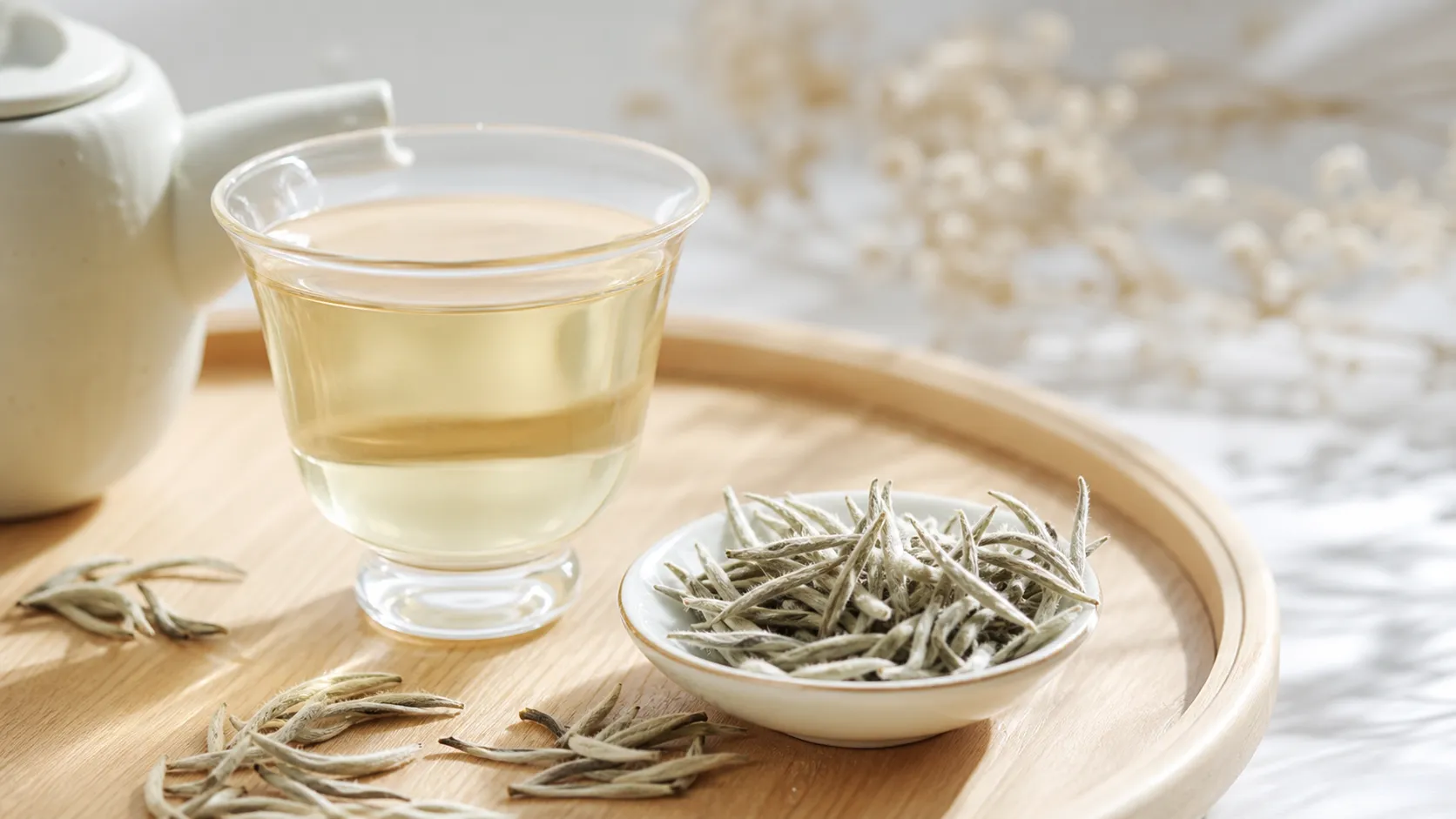
White tea is the least processed type of tea, made from the young buds and leaves of Camellia sinensis. The leaves are simply allowed to wither and dry, with no oxidation or mechanical handling. The result: 0 g net carbs, an exceptionally mild, slightly sweet flavor, and one of the highest antioxidant contents of any tea (Harvard T.H. Chan School of Public Health). At 15 to 30 mg per cup, its caffeine content is the lowest among true teas, making white tea an ideal choice for the afternoon and evening. The high catechin levels (especially EGCG) are excellently preserved by the gentle processing and support fat oxidation during a keto diet.
Is this recommended for keto?
White tea is unconditionally allowed on keto. Per 100 ml of brewed tea it contains, according to USDA data, 0 g net carbs and just 1 kcal. Its caffeine content of 15 to 30 mg per cup is the lowest among true teas (Camellia sinensis), roughly one third of the caffeine in black tea. Thanks to the minimal processing, only withering and drying without oxidation, the polyphenols and catechins are especially well preserved. Studies show that white tea can have a higher EGCG content than green tea, since the young buds are particularly concentrated. Antioxidant activity and protection against oxidative stress are therefore especially pronounced. Ideal as an afternoon tea or in the evening if you are sensitive to caffeine but still want to drink a real tea. It also works as a gentle companion to the first meal after intermittent fasting, since it does not overload the stomach or circulation. Brand recommendation: High-quality white tea from China: Silver Needle (Bai Hao Yinzhen) and White Peony (Bai Mu Dan). Brands: Tea Mountains, P&T Berlin, Ronnefeldt, Tee Gschwendner, Pukka White Tea or Tea Forte White Tea offer reliable quality.
What pairs well with it?
White tea harmonizes with light, delicate dishes and develops its subtle aroma best alongside foods that do not compete with it. Classic pairings: fish such as salmon, trout or sea bass, salads with avocado and grilled chicken, mild cheeses such as mozzarella, fresh goat cheese or young Camembert, as well as poultry and seafood such as shrimp or scallops. Its discreet, slightly sweet aroma also works wonderfully as an afternoon tea with keto baked goods such as almond-flour muffins, coconut cookies or a slice of keto cheesecake. For a summer variation: cold-brewed white tea with fresh berries (10 to 15 g, 2 to 3 g carbs), mint and erythritol makes an elegant detox drink. With a thin slice of organic lemon and a touch of stevia, it gains additional freshness. Important: brew white tea with water at only 75 to 85 degrees Celsius, otherwise the catechins are destroyed and the tea tastes bitter.
Pros & cons of organic
Advantages of organic white tea: Organic is especially worthwhile with white tea because the young buds are more sensitive to pesticides and, during the spring harvest (March to April), have developed few protective barriers. With the minimal processing, residues remain directly on the leaves, without being reduced by oxidation or roasting. Organic cultivation in certified regions of Fujian or Yunnan guarantees pesticide-free processing. Disadvantages: High-quality white tea, especially Silver Needle and Bai Mu Dan, is generally more expensive than other types of tea. Organic Silver Needle costs 30 to 60 euros per 50 g, since only the youngest buds are used and the harvest period is very short (usually only 2 weeks in March). Bai Mu Dan is significantly more affordable at 10 to 20 euros per 50 g and offers excellent value for money. Since white tea can be re-steeped multiple times (3 to 5 times), the price per cup becomes more reasonable.
Intolerances & allergens
White tea contains little caffeine (15 to 30 mg per cup) and is therefore usually well tolerated by people sensitive to caffeine. Tannins are present in lower concentrations than in black or green tea, which is gentle on the stomach. During pregnancy, 2 to 3 cups per day are unproblematic, well below the EFSA limit of 200 mg caffeine. As with all true teas, the tannins slightly inhibit iron absorption, so keep a 30 to 60 minute gap between tea and iron-rich meals. Allergies to Camellia sinensis are extremely rare.
Where to buy online or locally?
You can buy high-quality white tea online from specialty tea retailers: Tea Mountains, P&T Berlin, Ronnefeldt, Tee Gschwendner, Mariage Frères, Pukka. In supermarkets, good white tea is rarely available in satisfying quality. The main varieties: Silver Needle (Bai Hao Yinzhen) is the highest-quality variety, made exclusively from silvery buds from Fuding (Fujian), priced at 30 to 80 euros per 50 g. White Peony (Bai Mu Dan) contains buds and young leaves, is significantly more affordable (10 to 20 euros per 50 g) and offers the best value for money. Shou Mei and Gong Mei are cheaper variants with a stronger flavor. Brewing: 5 to 8 g of leaves per 240 ml of water at 75 to 85 degrees Celsius, steep for 3 to 5 minutes. Can be re-steeped multiple times (3 to 5 times with longer steeping). Store airtight, in a dark, dry place.
Nutrition values
| Nutrient | Per 100 ml (brewed) |
|---|---|
| Net carbs | 0 g |
| Fat | 0 g |
| Protein | 0 g |
| Calories | 1 kcal |
FAQ
Does white tea have more antioxidants than green tea?
Yes, some studies show that white tea can have a comparable or even higher content of catechins, particularly EGCG. The reason: the young buds used for white tea contain especially concentrated polyphenols. Due to the minimal processing (only withering and drying), the antioxidants are optimally preserved, whereas in green tea they are partially reduced by steaming.
How much caffeine does white tea contain?
White tea contains 15 to 30 mg of caffeine per cup (240 ml), the lowest content among true teas. Black tea has 40 to 70 mg, green tea 25 to 50 mg and matcha 60 to 70 mg. This makes white tea especially well suited for the afternoon, evening and for caffeine-sensitive drinkers. Longer steeping times and higher water temperatures extract more caffeine.
How do I prepare white tea properly?
Important: do not heat the water above 85 degrees Celsius, otherwise the delicate catechins are destroyed and the tea tastes bitter. Use 5 to 8 g of loose leaves (1 to 2 tablespoons) per 240 ml of water. Steeping time for the first infusion is 2 to 3 minutes, for subsequent infusions 3 to 5 minutes. High-quality Silver Needle leaves can be re-steeped 4 to 6 times, with each infusion revealing a different aroma profile.